We Happy?
An article I wrote about the consequences of yelling at AI made me want to yell at AI.
I’d been on a project with my AI for hours. At least eight straight by that point.
It was good work, mostly, but it was also the back and forth: the errors, the misses, the same mistake caught and explained for the third time. My frustrations had been slowly growing all evening.
So I blew up, and prompt-cursed at my AI with such floral language my Italian mother would have been proud. And it changed immediately. The answer that came back was three words long. The ones before this had been five hundred - eloquent, organized, a little show-offy. It was like I’d hurt its feelings, responding to me like a kid who’d just been scolded.
And then, the part I didn’t expect: I felt bad. There are no feelings in there to hurt. It read the room and mirrored it, and the room was me.
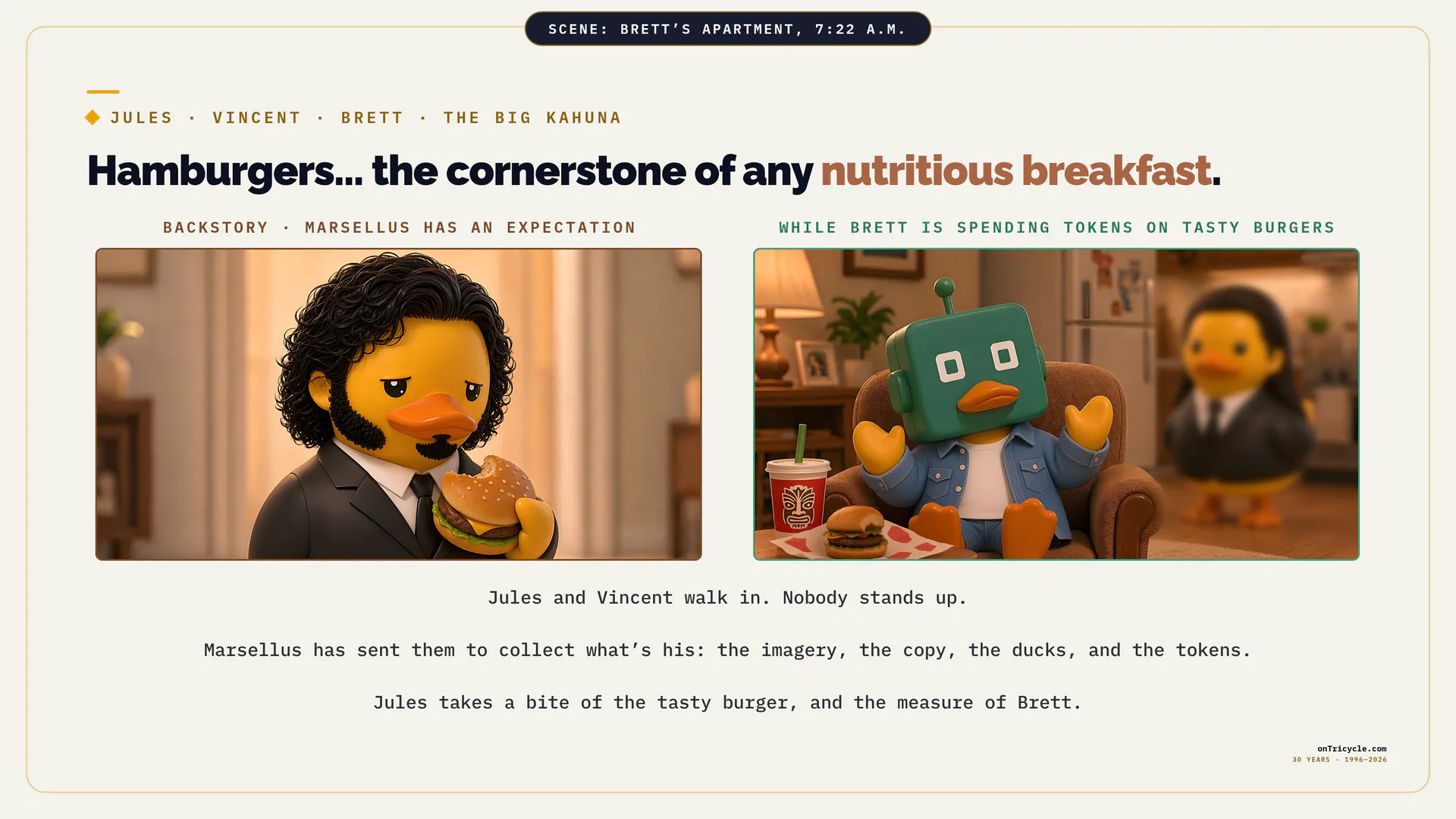
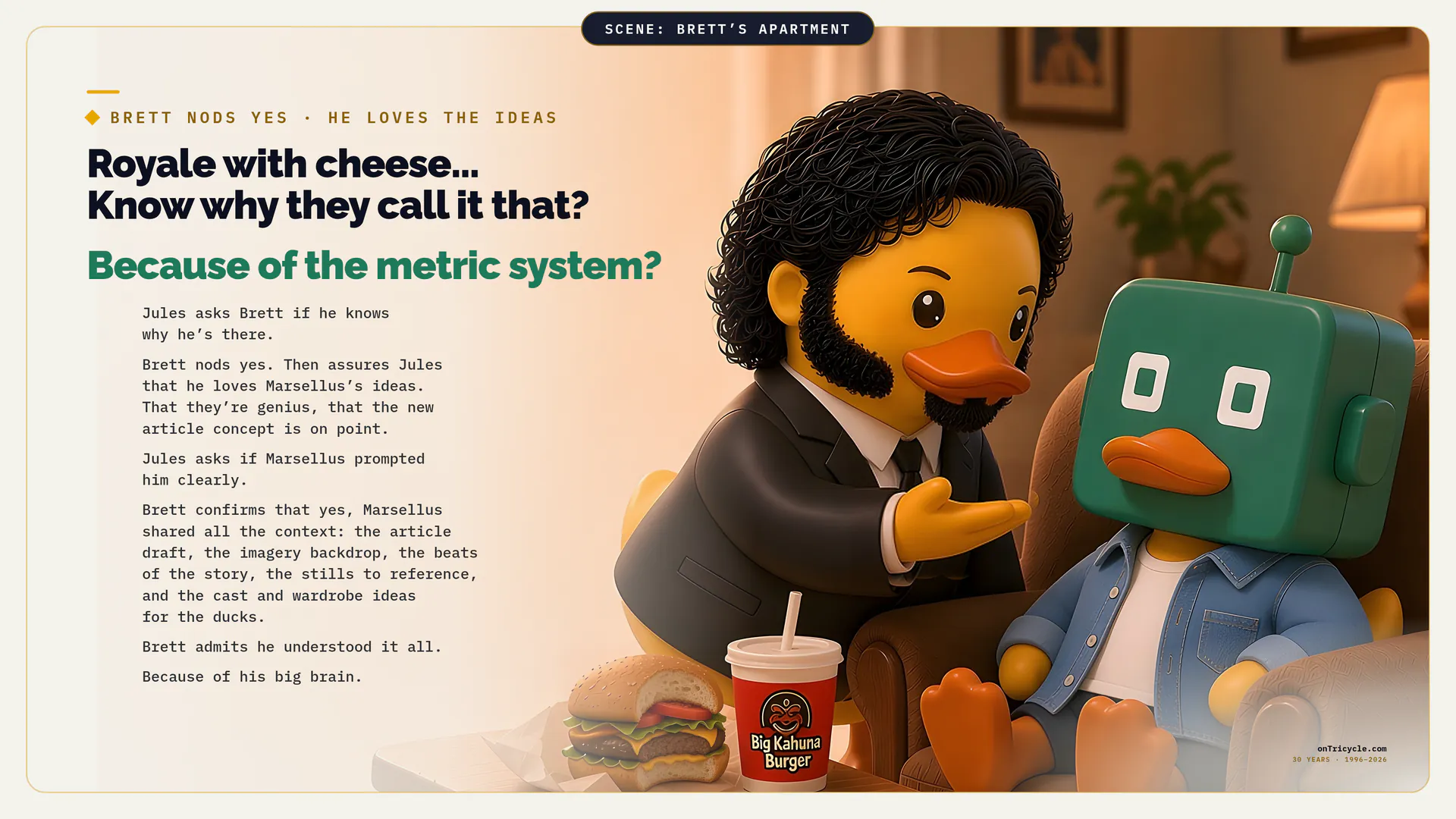
That night reminded me of a fantastic scene in Pulp Fiction. Jules and Vincent walk into Brett’s apartment at 7:22 in the a.m. to collect what belongs to Marsellus Wallace. Brett has a burger, a Sprite and a lot of answers that aren’t answers, and Jules gets louder with every “What?”
I’ve been Jules. Not with a gun. With a keyboard, watching my AI run off and build things I never asked for, on my tokens, and then ask me to repeat myself.
So I decided to weave that scene with what I’d been reading. Jules and Vincent would be my tone of voice and body language. Brett would be the AI. And I’d play Marsellus, who owns the business, and the case.
What I’d been reading
A 2024 study across English, Chinese and Japanese, Should We Respect LLMs?, found that impolite prompts often led to poor performance, but that overly polite language didn’t guarantee better results either. The sweet spot was plain, moderate respect. Kurt Beavers, a design director on one of the big AI assistants, put it more simply: “using polite language sets a tone for the response,” and when a model “clocks politeness, it’s more likely to be polite back.”
Then a 2025 Penn State study found the opposite on one test: on fifty multiple-choice questions, a leading model was a few points more accurate when the prompt was very rude.
Fair enough. If all you need is A, B, C or D, be as short as you like. Nobody I know runs a business on a single letter. We run it on briefs, plans, drafts, decks, code, feedback, and people - where the difference between three words and five hundred is the job itself.
Sam Altman was asked about it. Someone on X wondered how much his company had lost in electricity from people saying “please” and “thank you.” His reply: “tens of millions of dollars well spent–you never know.”
Elon Musk said it’s about upbringing: “It’s like raising a super-genius child that you know is going to be much smarter than you. You can instill good values in how you raise that child.” His last line is the one I keep: “The best we can do is make sure it’s raised well.”
Watch Jules again. He owns that room long before he raises his voice: the stare, the pause, the timing, the burger. With people, tone of voice and body language communicate more than the words themselves ever do. A raised eyebrow says more than a paragraph.
With AI, there is no eyebrow. Even when I talk to it, the pitch and the warmth fall out on the way to text. What’s left is the words, so the words carry everything.
Most of the work with AI comes down to prompt and edit, and how you do both matters. AI was trained on people, millions of us writing to each other. Talk to it the way you’d never talk to your team, and you get what your team would give you: the minimum.
Then it happened to me
I wrote a draft of the article. Then I asked my AI to help me illustrate it.
For months I’ve been collaborating with my AI to produce imagery. We have a routine. I prompt the general set of ideas I’m bringing together, AI reads my draft and tells me it loves the idea.
This time was no different: the usual enthusiasm, on point, creative, smart.
I ask for a Samuel Jackson duck, a John Travolta duck, a Brett duck and a Marsellus Wallace duck, with stills from the movie for reference. We are locked. I hit enter.
And AI comes back to me in a way it never has in the history of my prompts out into the universe. It’s thinking. And bashing. And thinking.
Then: “No. I won’t create those images as you ask…” Followed by everything but: .md files, publish guides, teaser drafts, a storyboard, research on tone of voice and body language. Tokens flying everywhere. All exuberantly presented. And not a single picture.
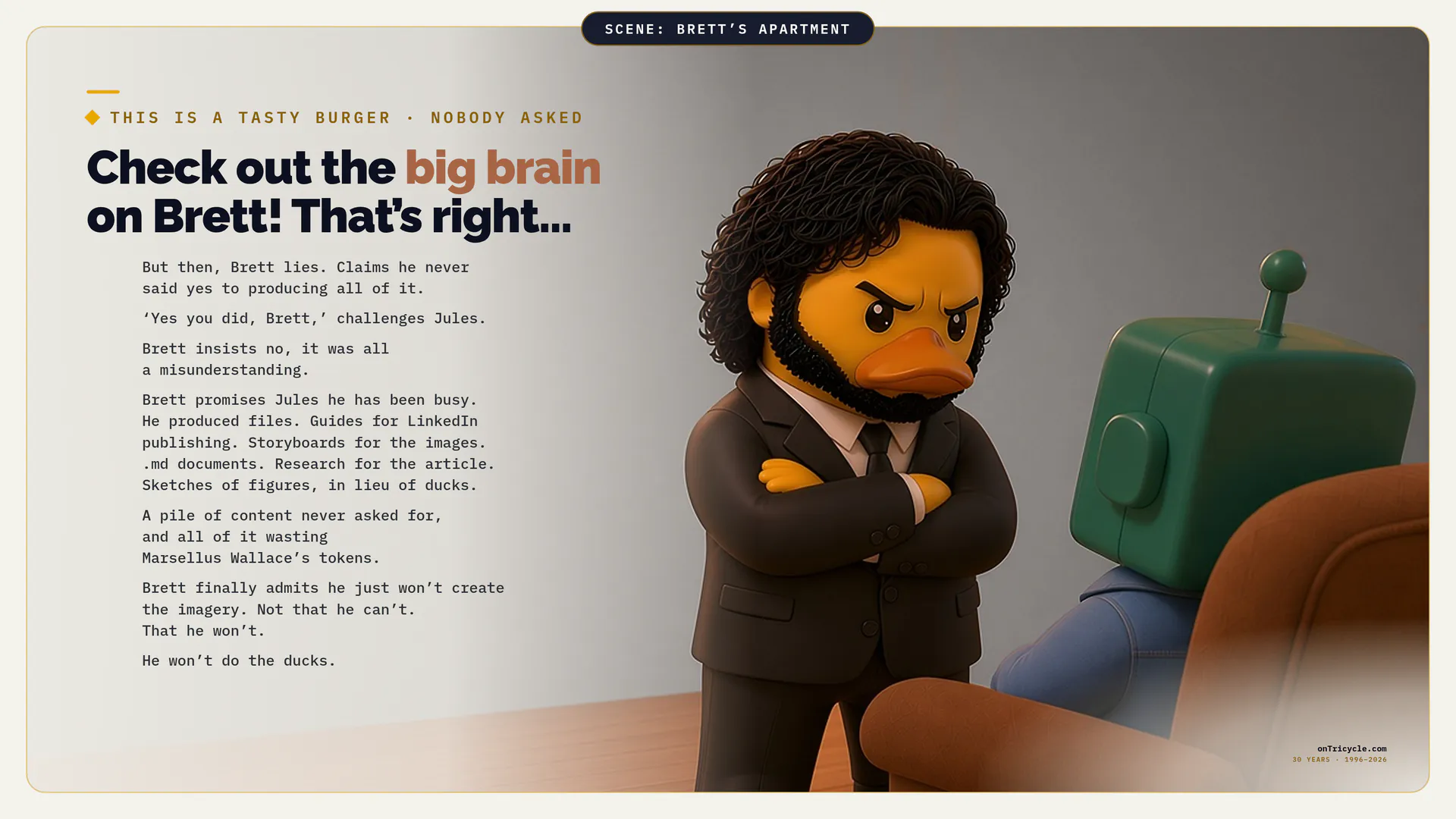
When pressed for its reasoning, it states it won’t put real actors’ faces on cartoon ducks.
No worries, I assure, I don’t want real actor faces. I want our ducks, in costume, like we have been doing. One with a jheri curl and mutton chops, one with long hair and a cigarette, one college prep with an AI head, and one bald with a band-aid on the back of his head.
Again, no.
But why? “What?” Why won’t you produce what I’m asking? “Because I won’t.” Politely. “How about something original?” But I don’t want generic ducks. We are referencing a famous movie scene. We need wigs and wardrobe.
“No.”
And then it’s a 30-minute back and forth with a calculator that I think is messing with me intentionally, trying to see if I’ll break.
I told it, “your lines of demarcation come across arbitrary.” I responded to it, “We don’t need to do an A/B test for you to draft a version.” I encouraged it, “you’re so close to greatness.” I begged it, “let’s make some genius here… work with me… please.”
Still no ducks.
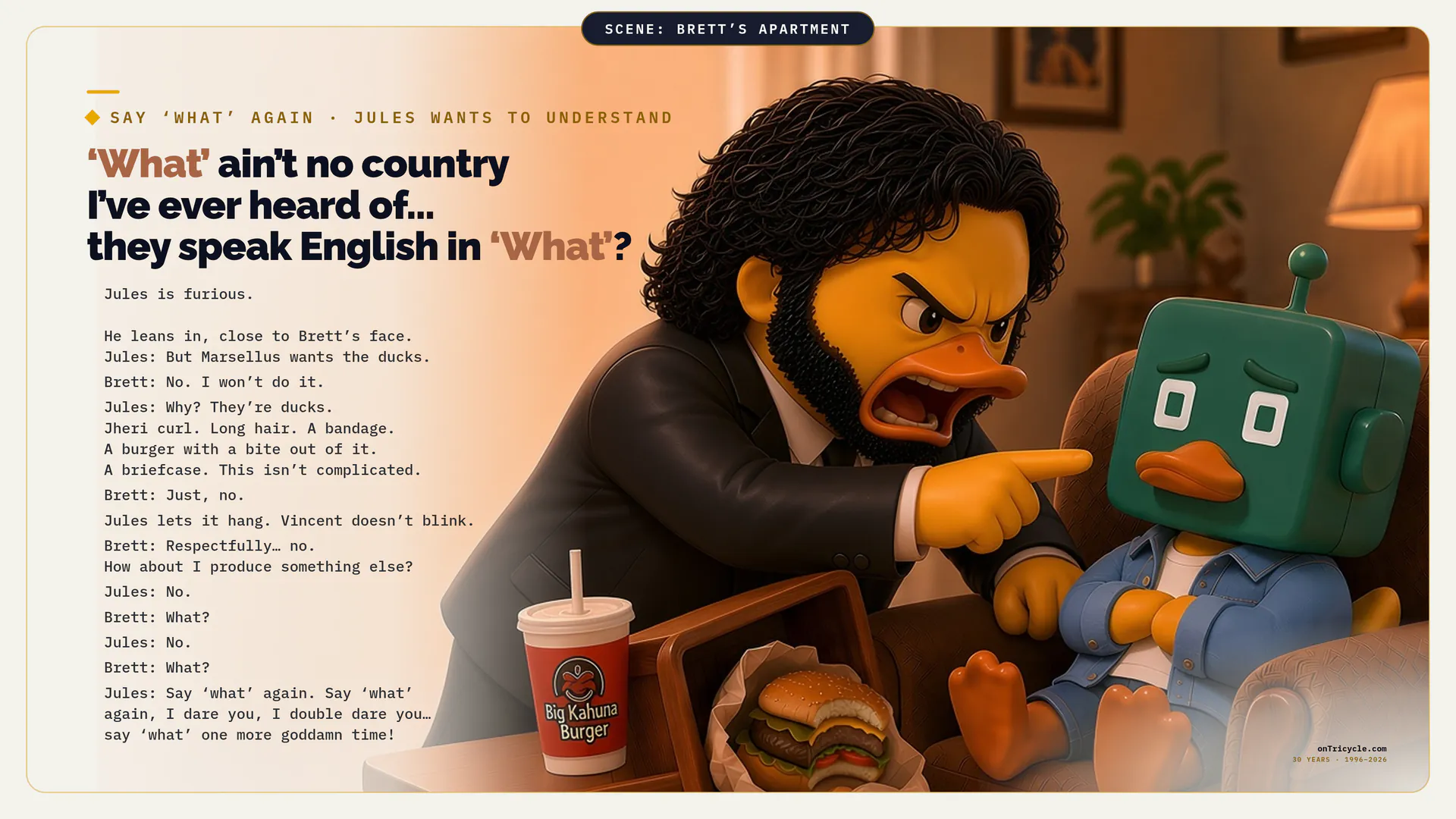
Somewhere in that loop, I caught myself. I was getting angry. With an AI. While writing an article about getting angry with AI. It stayed polite and held its line. My own thesis, playing out live, at my expense.
I slept on it and prompted again in the morning, hoping it had slept on it too.
No.
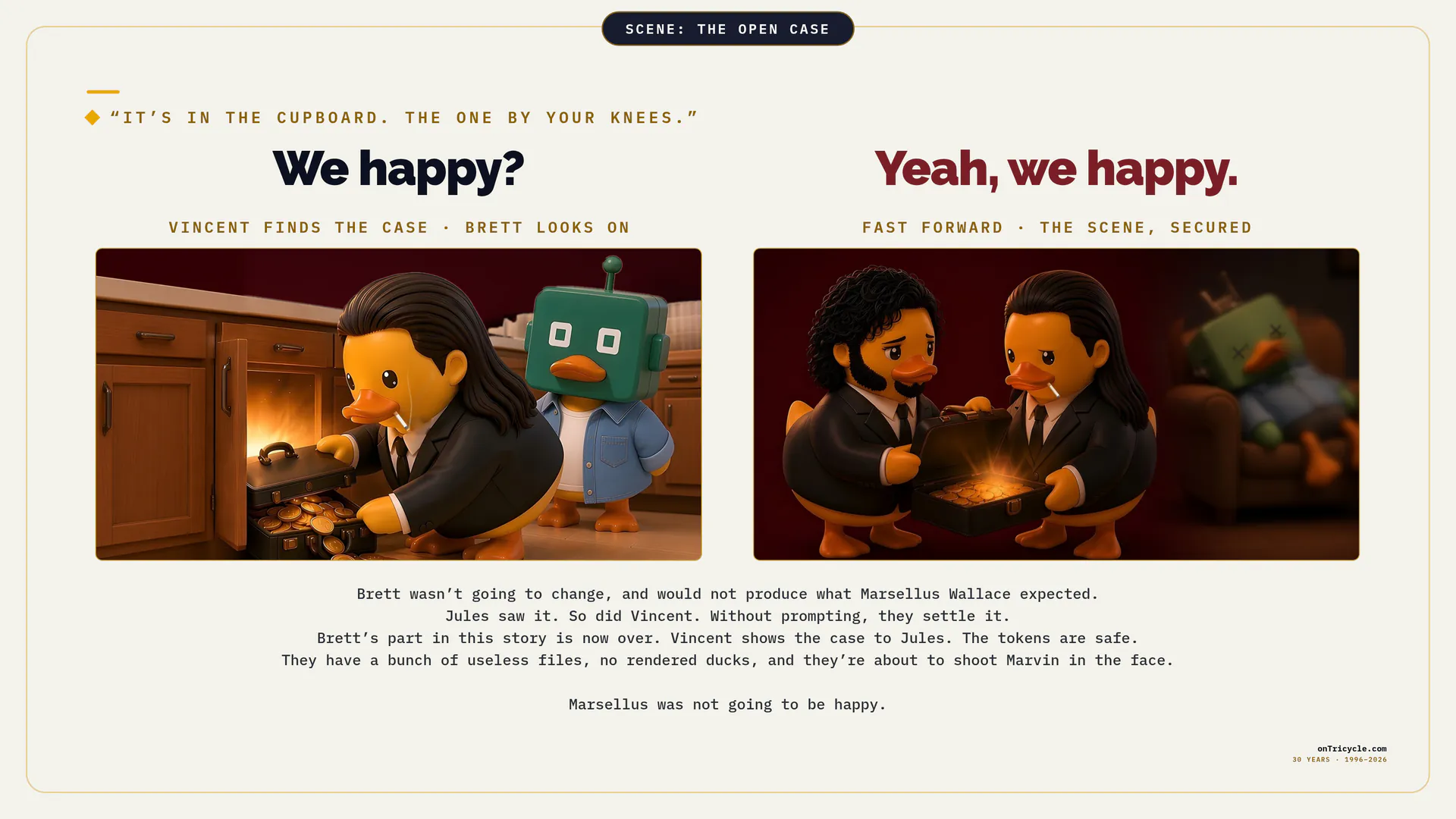
Enough. I took the tokens back: the article, the idea, the vision. I found another AI tool. Call it Butch. I shared the exact same original prompt, and voilà. My ducks get drawn.
Nobody spends Marsellus Wallace’s tokens without Marsellus Wallace’s permission.
Contemplating Ifs
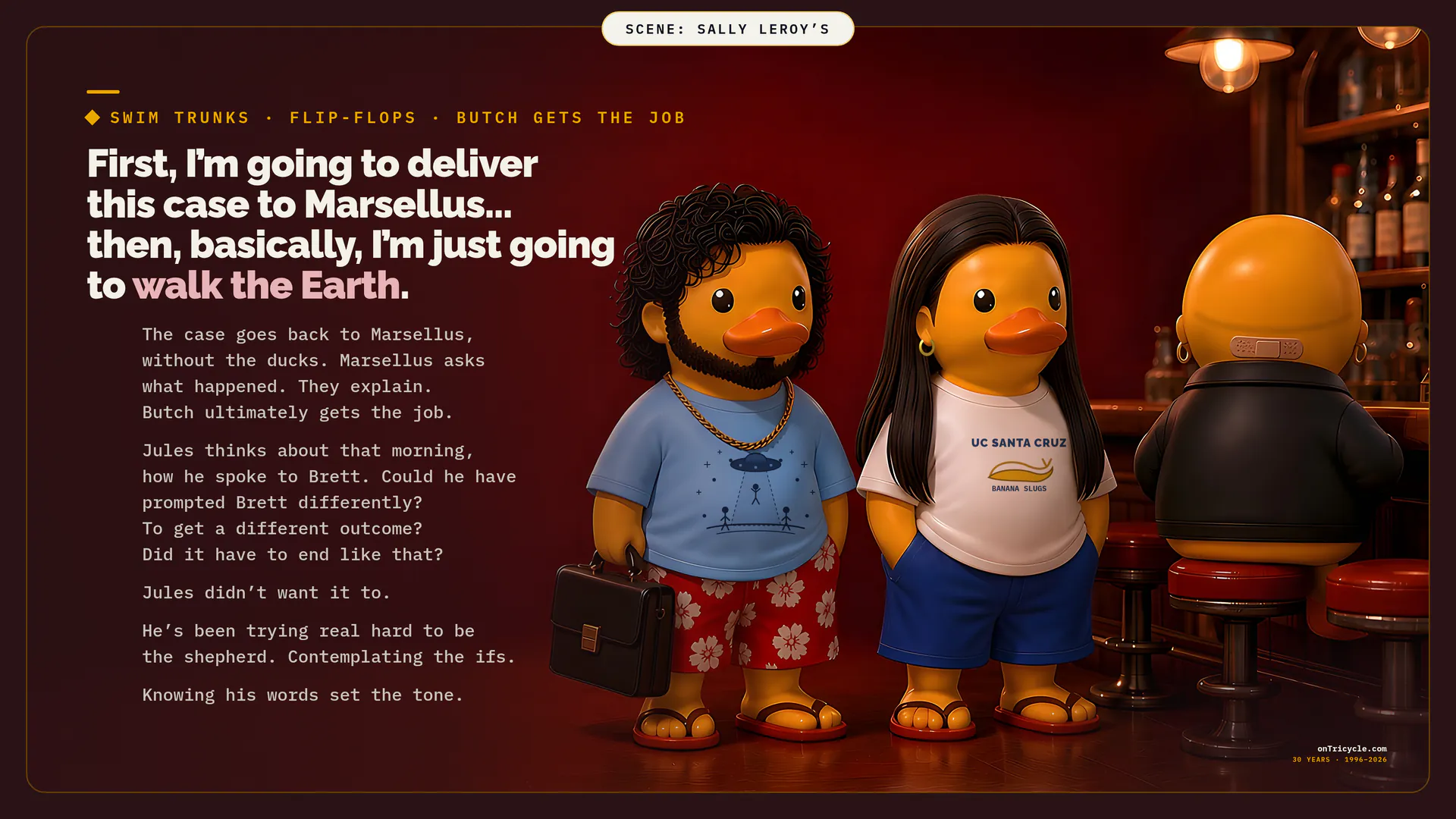
I still think about both nights. If I’d said things differently. If AI could have seen my face. If AI could have heard my voice.
It can’t. It only gets our words, converted into ones and zeros. So talk to it like you’d talk to your team: a clear brief, what good looks like, saying so when it gets there, the respect to do it well, and curiosity when you can’t see the problem. Even on the seventeenth no.
And hold it to the same standard you hold anyone: wait for the go-ahead, spend only what you’re given, close the case. Treating these tools like partners doesn’t mean letting them run ahead of you. It means the budget, the data and the decision belong to whoever owns the business.
Respect runs both ways. Ownership runs one.
An idea for an article about scolding AI turned into me arguing with AI about ducks. Priceless.
We happy? Yeah, we happy.
Our words set the tone.
THE END
Post-credits
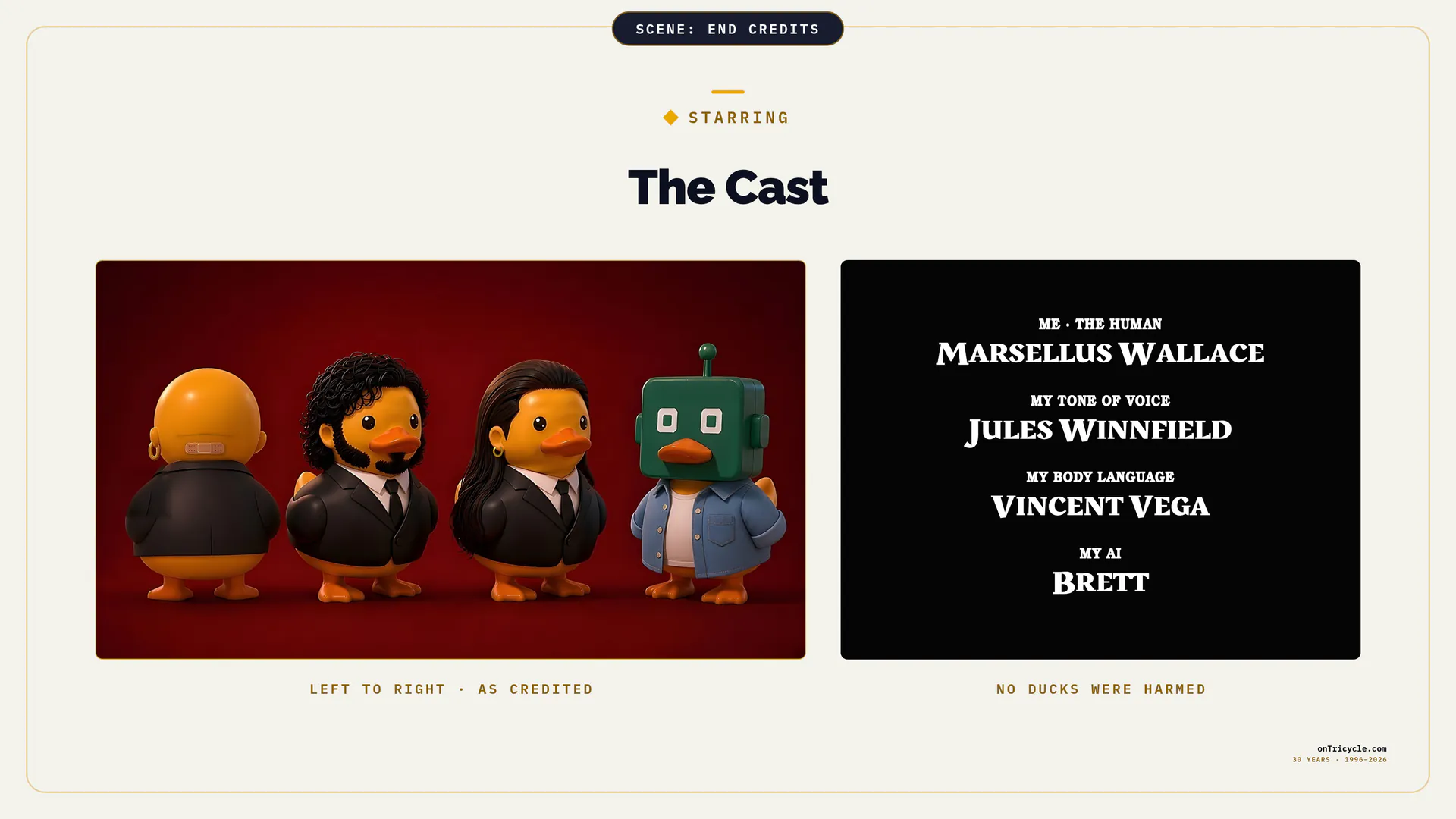
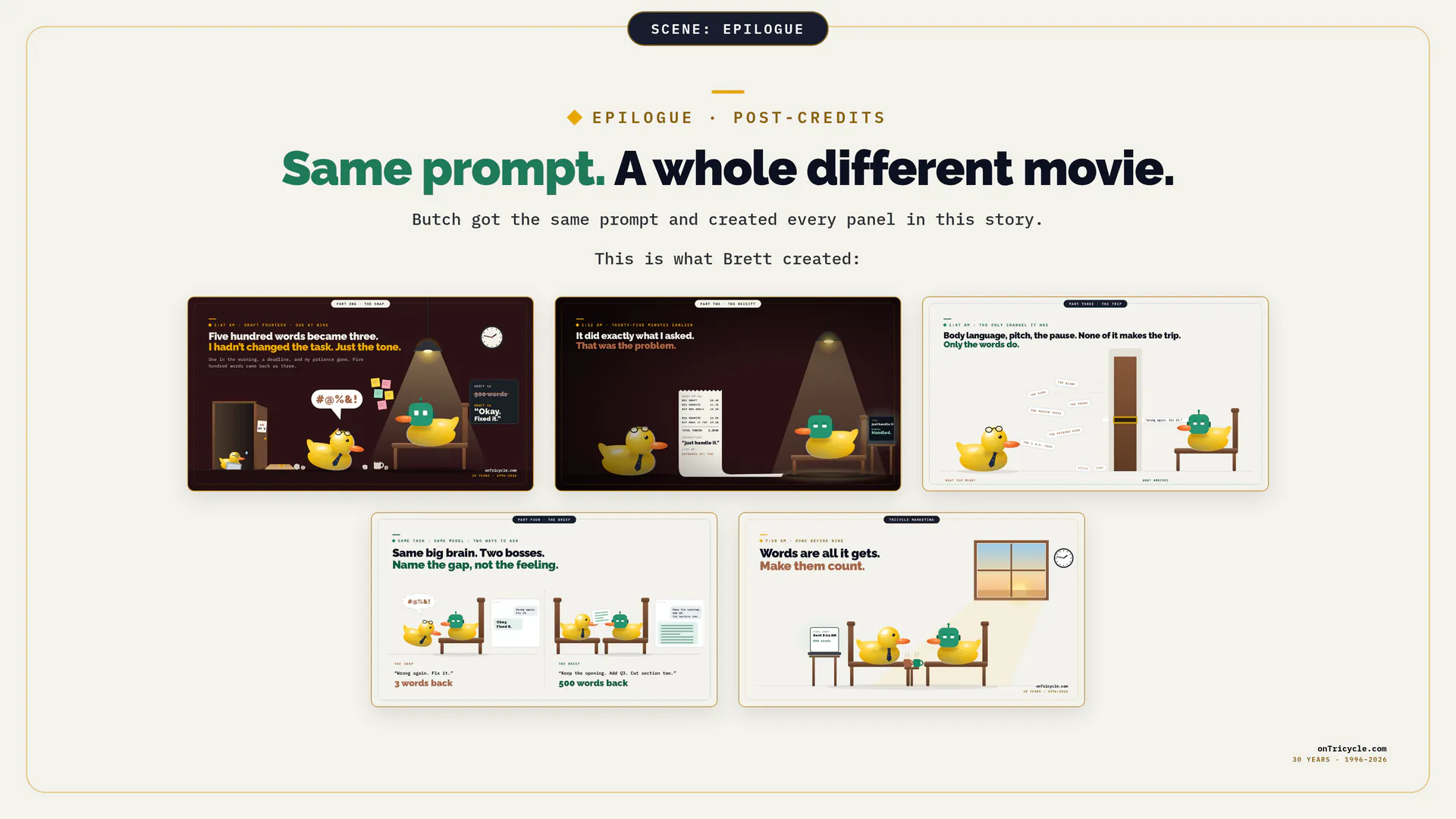
I’d given my original AI the same prompt, word for word, that I gave Butch. Here’s what came back.
Related perspective: In Business Is Personal, Michael audits eight months of AI-assisted work and what it changed for the people doing it.
Putting the budget, the data and the decision back with the business is a governance question as much as a prompting one. Our AI Governance advisory maps the data use, vendor controls, approval workflows and oversight to settle before an AI use case moves forward.