Business Is Personal
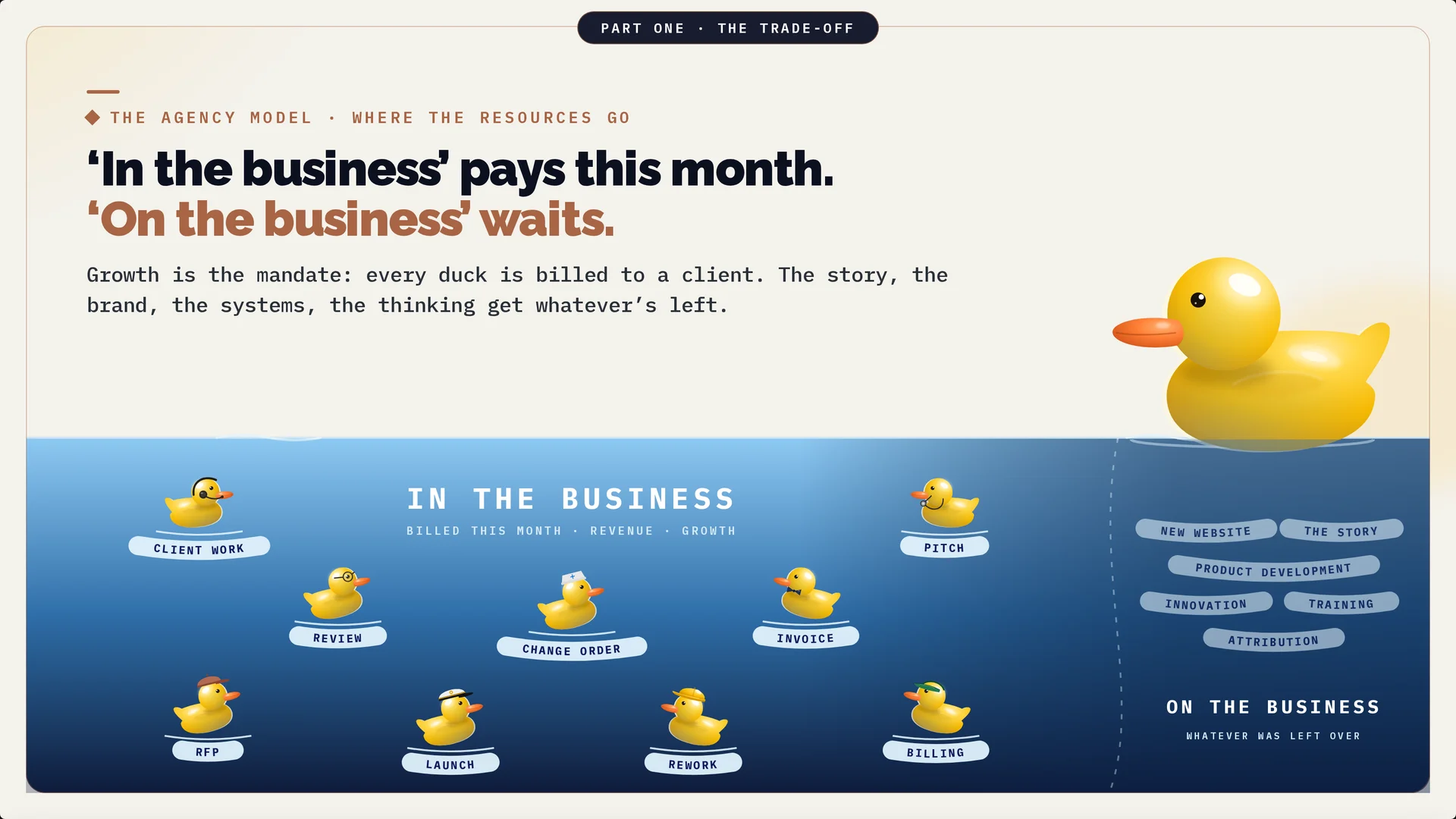
One of my mentors, David Williams, lived by three tenets, and said them often enough that they've stayed with me through the years. Business is personal: the people you work with are, in a sense, family. There's working in the business and working on the business, and both matter. And once a decision had been weighed and made, and we were all in on a BHAG - his word for it, a big hairy audacious goal - he'd remind us that he liked our odds.
Believing business is personal is how I grew high-performing teams and vibrant cultures: relationships founded in trust, healthy conflict and shared goals. Balancing those teams between working in the business and working on it was far harder in practice, because working in the business is what generates revenue, and growth is the mandate at nearly every agency on the planet - for the CEO, the CRO, the CCO. So you bill as many ducks as you can to clients every month, and the story, the brand, the systems, the thinking get whatever's left over, which is comparatively little. Time and people are finite, and given the choice between paid work and internal investment, paid work wins - the odds were always in its favor.
AI vs. the calculator
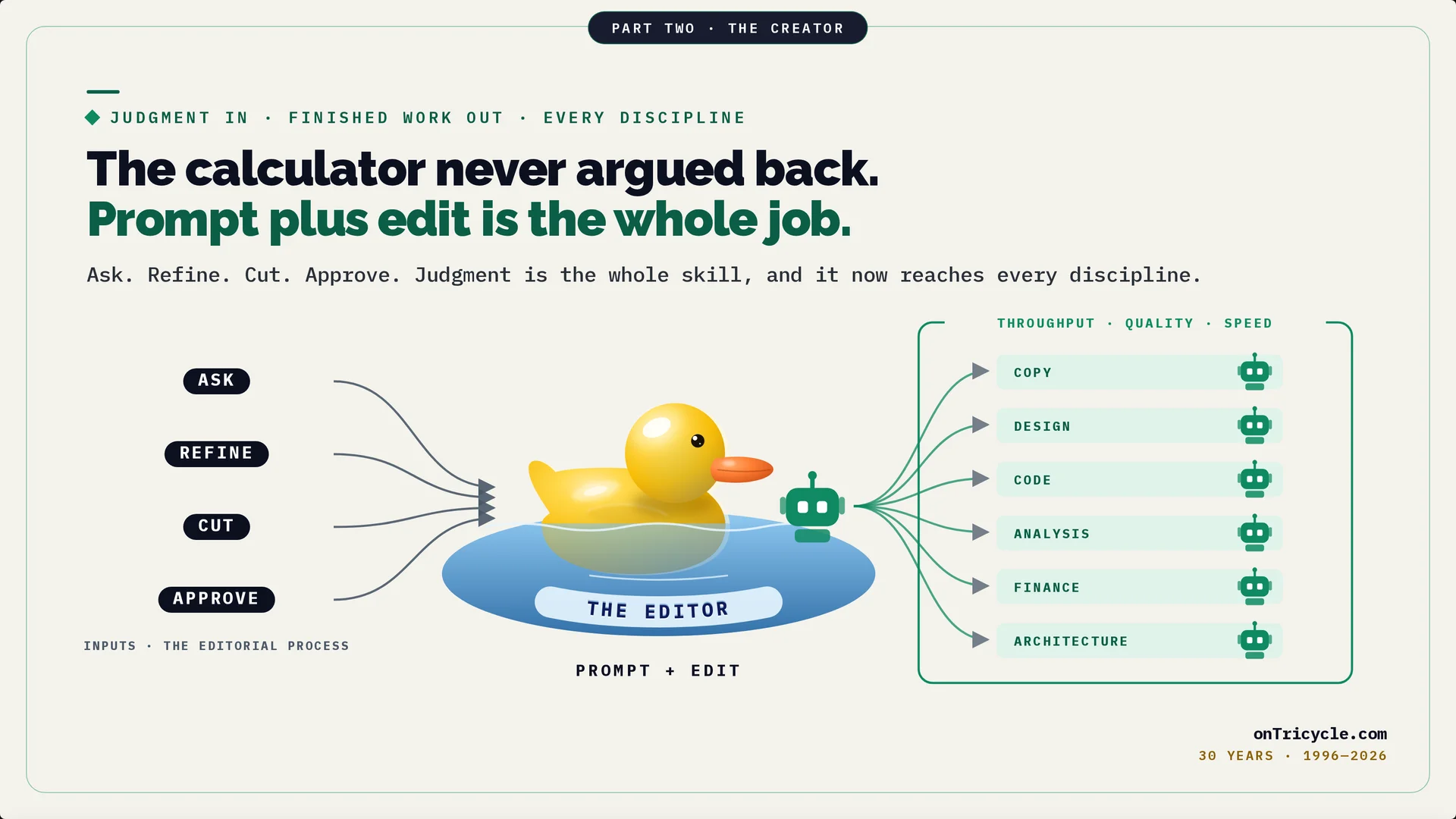
A few years into AI, everyone I know sits somewhere on the continuum - from tried it a few times to running their business and their life with it. I'll admit I felt an odd stigma about the tools at first - the kind where using them felt like a shortcut you didn't mention in the meeting. But then I tried the tools everyone names: ChatGPT, Claude, Gemini, Copilot, Grok. Over time, which one was better stopped being the most interesting question. And when a friend who once ran marketing for a global electronics brand equated using AI to using the calculator, whatever stigma I felt evaporated, because he's right - with one amendment: the calculator never argued back.
The difference between someone great with AI tools and someone who isn't as great is never just the prompt. It's the editorial process - what you ask for and how you define success, what you refine, what you cut, what you approve, and what you send back four times before you do. Prompt plus edit is the whole job, and it turns out to be the job of a creator. With judgment, we can now learn and create in disciplines that were never our specialty, at a throughput, quality and speed that used to take a floor of people.
And that efficiency dissolves the trade-off. You can work on the business without pulling a single duck off the work in it. We all have a version of this - working on ourselves versus doing our work - and the balance usually tips one way or the other. That trade just stopped being necessary.
The audit
I prompted Claude to audit everything we'd built with it: since February, eighteen projects. The types are the interesting part: the company story, and the website built from it; client briefs and prospect briefs; presentations and pre-reads; a demo environment with eight months of synthetic history, and the data loads to fill it; a financial audit of our business through views we've never had; a technical and design audit of our own platform's UI/UX; a paid campaign and an outreach engine; articles, and the illustrations under them; and a knowledge vault that ties all of it together - every source, every decision, every draft - so nothing gets explained to the tools twice. Roughly 4,700 files, two million words, 2,800 images, 800 pages of PDF.
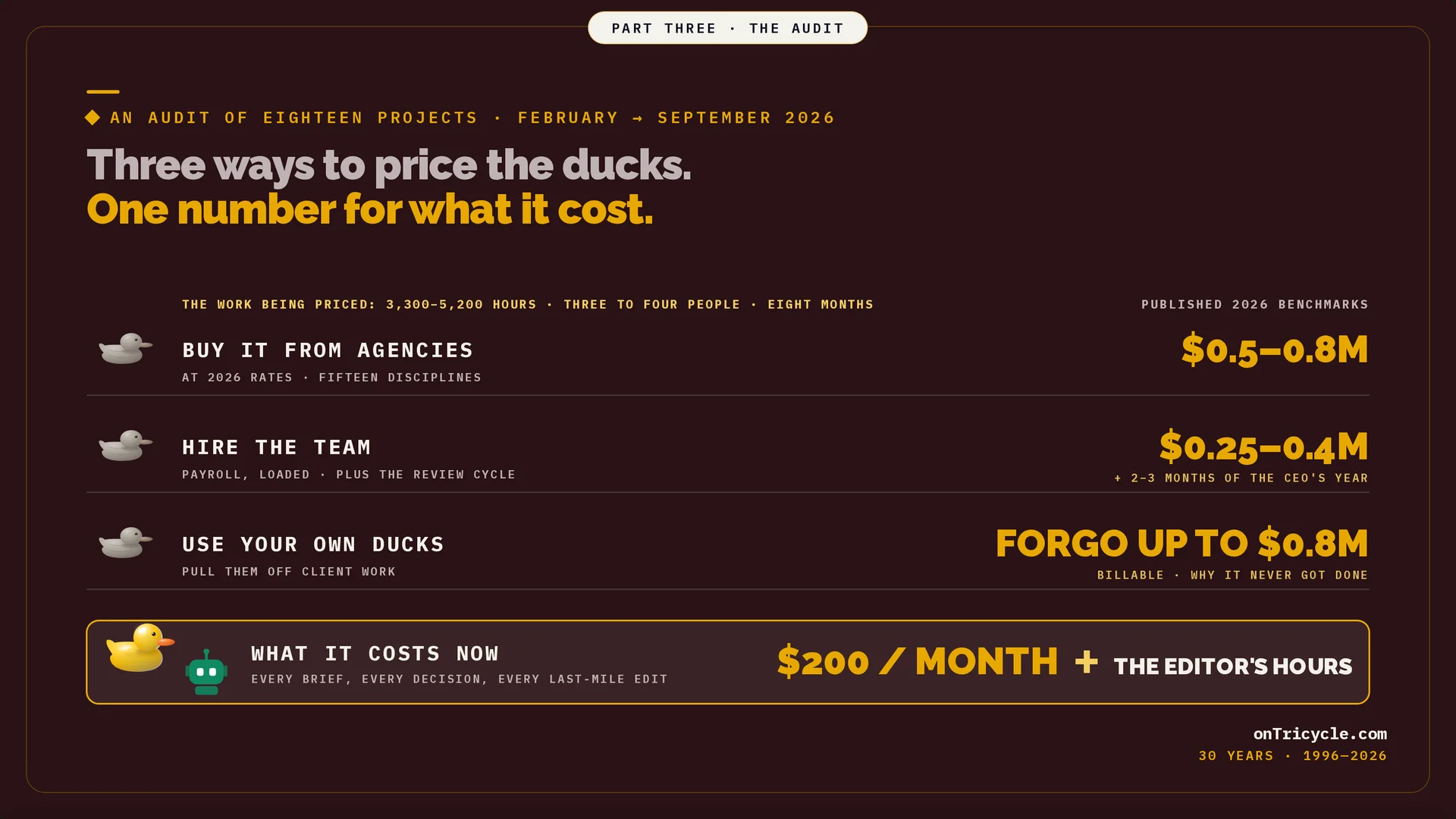
Then I prompted Claude with the question I answer for a living: what would that have taken without AI? Fifteen disciplines. Three to five thousand hours - three to four full-time people for eight months. There are three ways to price it, and I've sold all three. Buy it from agencies at 2026 rates: half a million to eight hundred thousand dollars. Hire the team: two hundred fifty to four hundred thousand, before the two or three months of my own year it takes to brief, review, approve and reconcile them. Or do it with your own ducks, and forgo up to eight hundred thousand in billable hours to build your own business - which is exactly why it never got done.
What it costs now: two hundred dollars a month, and the editor's hours - every brief, every decision, every last-mile edit. Hours I'd have spent briefing and reviewing anyone else's work anyway.
What it showed
Two things the invoice doesn't.
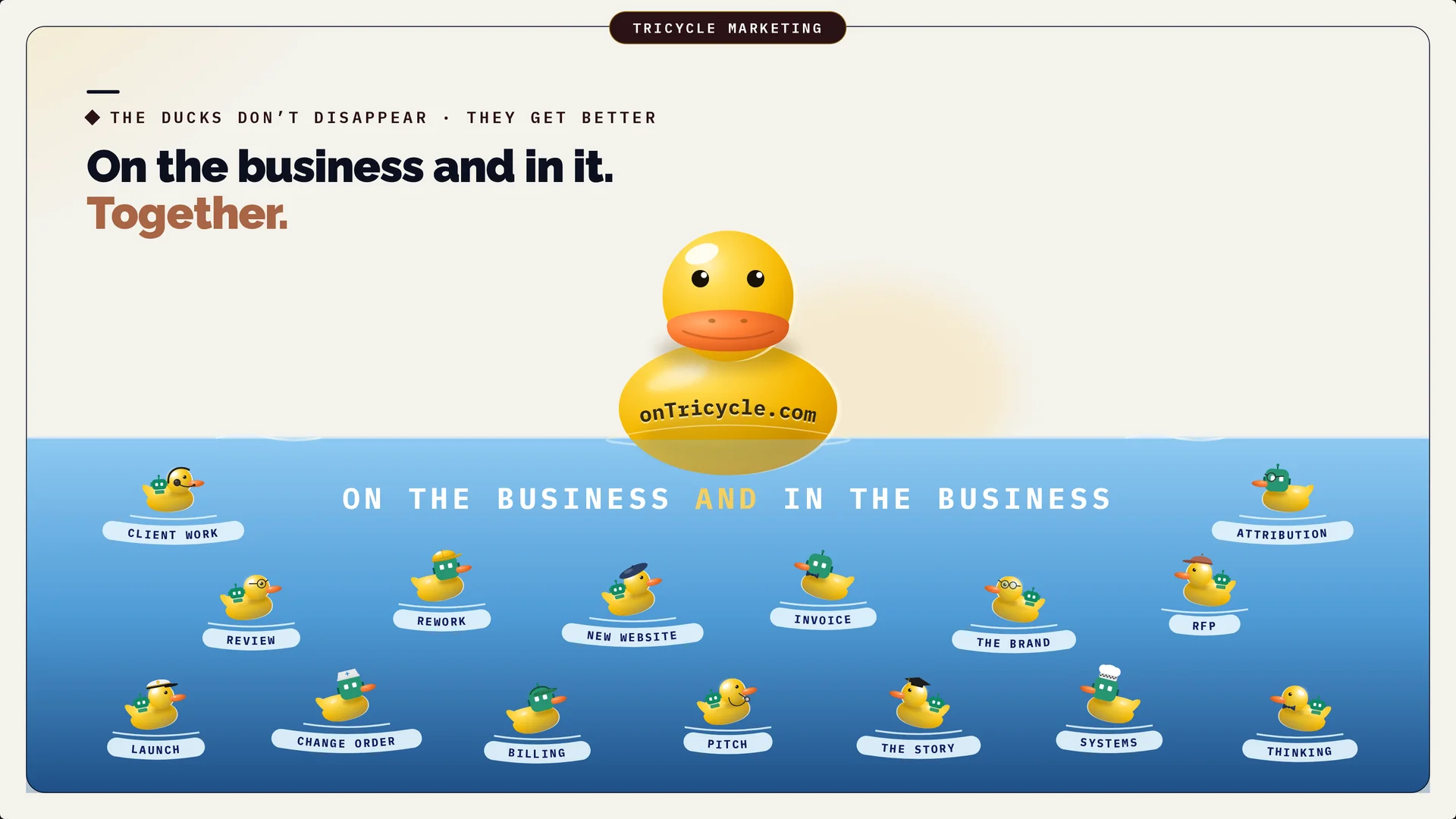
The fear about these tools is that they replace the ducks. What I experience is the opposite. The ducks don't disappear - they get better. The tools equalize output: a junior project manager can produce a senior-looking plan in ten minutes. And they amplify judgment: the senior one knows which three of its forty lines are wrong, and that was always what anyone was paying for. Every duck that picks up the tools gets the reach of disciplines beyond their own, without giving up the one they trained in. The talent was never the constraint. The hours were.
And David's second tenet, settled. When I sorted the eighteen projects, eighty-two percent of the hours were work on the business, and not one of them came off a client's invoice. The work nobody was ever going to pay for got done.
Which brings back David's three tenets, in order.
Business is personal, and it stays that way - the tools don't change who you're in it with. I produced all of that without spending anyone's time, anyone's money or anyone's weekend, because the ducks I did it with were AI and its agents. And I'm better with my people because of it: there's more of me to bring, and less of them stretched to cover. The family got bigger, too. Our team, the Tricycle Studios network, our clients, our prospects, our partners and providers - everyone I've asked is leveraging the tools, and the work we do together is faster, cleaner and further-reaching than it was when people were the only capacity we had.
Working in the business and on it - and on ourselves - can now happen at the same time, at a level that wasn't available to anyone before. This year we flipped the script on the oldest trade-off in the business, for two hundred dollars a month.
And now, when the decisions are made and we're all in on the BHAGs in front of us, we ride a rising tide of AI capability, and every one of us ducks rises with it.
I like our odds.
Related perspective: In I Loved Change Control, Michael examines the agency model behind the ducks and the invoice.