I Loved Change Control
For more than thirty years I sold and implemented enterprise loyalty technology - and every service we could wrap around it, creative and otherwise. I ran those businesses: platform contracts, implementations, the commercial apparatus underneath them.
And I loved change control.
I loved long implementations. I loved retainers for teams we could dedicate (ahem) to the client. I loved platform contracts where our revenue climbed as the client's program grew - their success was our billing event, built that way deliberately. I loved running the platform on the client's behalf, because it meant they couldn't run it without us.
I also loved the ducks.
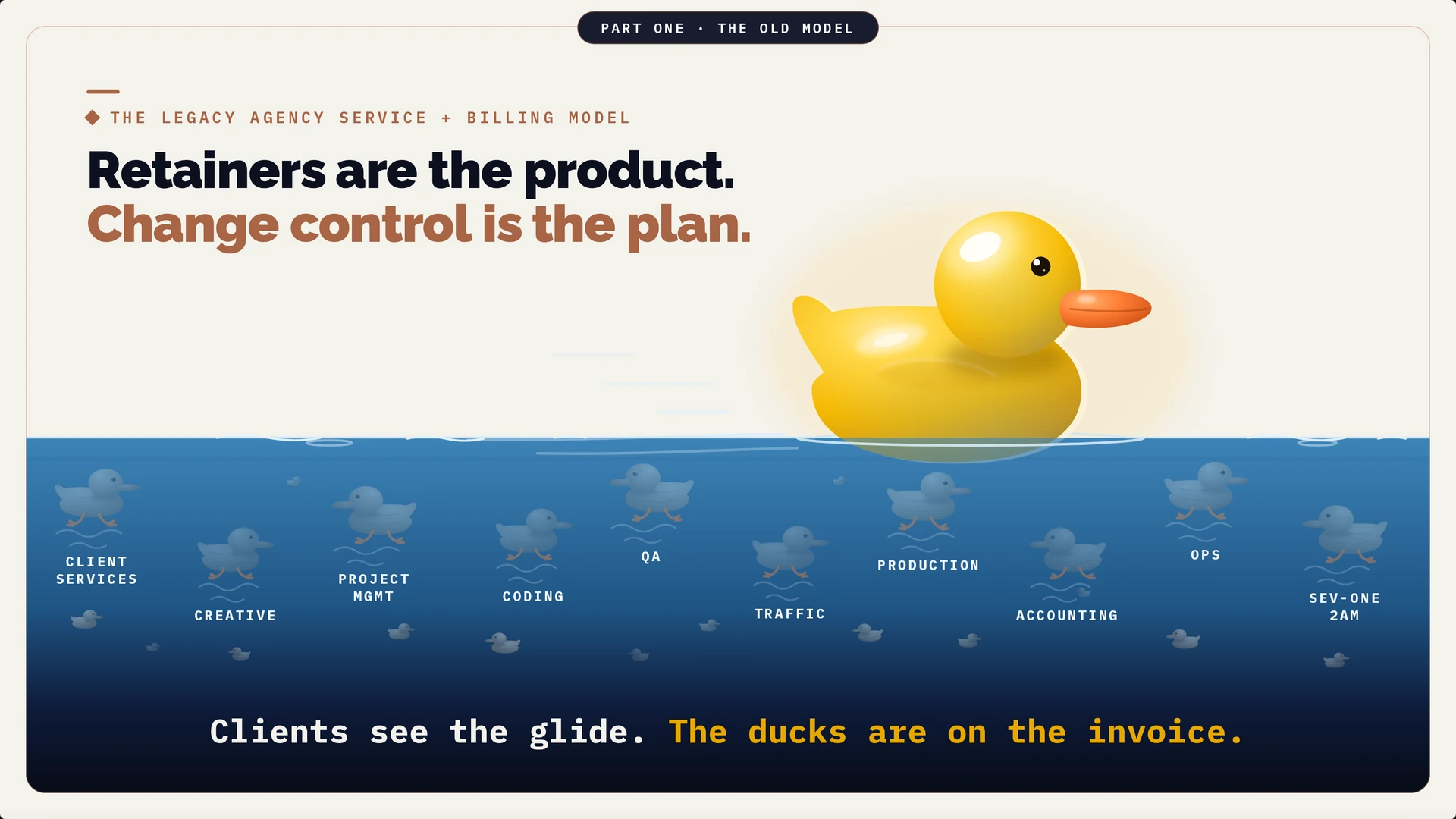
The team would laugh at the comparison. It started with something I said to an engineer who was coming apart during a bad night - the client doesn't see the ducks paddling, they see the glide, so keep paddling and keep it smooth. We were all the ducks, me included.
There were a lot of us. Creative teams, client services, project managers, documentation, QA, whoever picks up a severity-one at two in the morning. I loved growing that. I loved it when they won the work and when they got retained and when the work was good. I loved moving people from one project to the next. Hire more, deploy them against client work as hard as you can, carry them in the gaps, hire, train, sometimes let go. Internal projects got whatever was left over, which was usually nothing - unless a creative director had a point to make, and then they got rather a lot. The creative directors circled each other. That was normal too.
That's how the model was built, and how everyone in it was incented. The businesses I ran on it grew from $6 million to over $100 million in revenue. It worked.
What InsightsOutward is, and how
I didn't start Tricycle. What brought me to it was a sentence.
Don Hughes had been building InsightsOutward™ toward one idea: make it so the client can run it without us - whether or not they ever buy the source code.
Here's what that rules out. You can't meter transactions, because a client running it themselves isn't sending you transactions to count. You can't charge per member. You can't hold a change-control desk, because the entire point is that they change it. And you can't leave a gap in the product you'd normally cover with a services line, because there is no services line waiting.
That is most of the legacy SaaS model, and every one of those is a revenue stream I used to sell.
What's left is a platform rather than a subscription. Configure once, run anywhere, own the outcome. Consumer, partner and employee programs on one governed instance instead of three systems that never speak. A reward ledger that survives an audit, because a currency you can't account for isn't really a currency. A fixed fee, or buy the source code outright and hold it as an asset. It runs in the client's own cloud, and we don't see the data.
None of that is generosity. It's what the constraint leaves behind.
What Studios is, and how
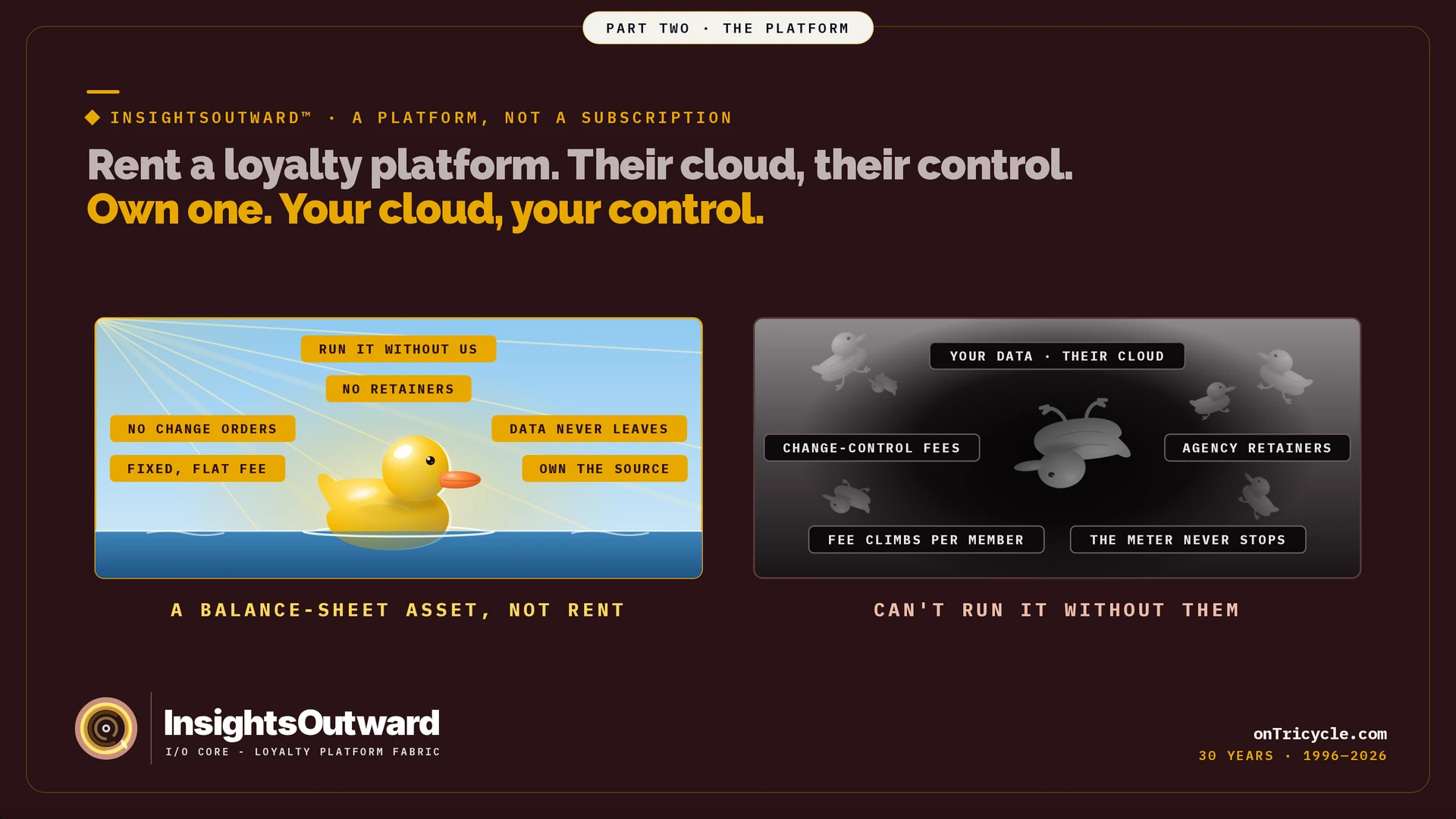
Studios still runs on ducks. It just doesn't carry them.
That decision was made years before I got here, and I've come to think it's the same decision as the other one. Studios was built the ordinary way once - staff, floors, a standing bench. Then the model shifted, and rather than defend the shape, it went to the people already doing the work: firms and individuals expert in one thing. Film. Design. Media. SEO and GEO. UI/UX. Regulated copywriting. Fifteen disciplines, a network of a few hundred specialists, assembled per engagement across strategy, concepting and production.
The cost argument is the obvious one and it's real - no bench overhead to pass along. The bench built a great deal of good work over the years, mine included, so that isn't the argument that convinced me.
A firm devoted to a single craft stays at the edge of it in a way that someone carrying it as one of nine responsibilities cannot. And when one stops performing - late, over budget, defects, hard to work with - we find someone else. Nobody gets carried, nobody gets reallocated to fill a gap, and there are no internal politics to lose to, because there is no internal. You can't say any of that about a bench. That's the part that never appears as a line on the invoice.
Which creates an obvious problem. If you don't employ the people, how do you govern them? Not with a spreadsheet. So Studios built the thing that could: scoring, timestamps, rework counted rather than estimated, a performance record that follows each specialist between engagements. A long-standing client later asked us to compete on creative capability and price, and instead of a rate card we showed them that. It became I/O Procurement Intelligence™.
Procurement Intelligence isn't a third capability. It's the loyalty platform pointed somewhere unexpected. Underneath the category name, a loyalty platform does something plain: it measures behavior, scores it, and moves it - with or without monetary value attached. Point it at consumers and you get a rewards program. Point it at the agencies producing your regulated creative and you get vendor scoring.
Momentum
Here's the part I didn't expect.
A card issuer with a different vendor behind every one of its programs, working out what one ledger it owned would change. An auto services business with thousands of locations, replacing the platform behind its consumer program. A marketing agency serving a hundred brands, that wants the platform underneath its programs to belong to it rather than to a vendor. A global life-sciences company rebuilding its operating model around self-directed teams, and needing to see how its vendors are performing underneath it. A medical device company connecting the content its field team uses to the products that actually sold. A medical imaging manufacturer whose most valuable relationships are with clinicians and biomedical engineers. A manufacturer whose real loyalty question is repeat business across sites and segments, currently measured by a survey. A member-owned buying group that has never once called what it does loyalty - and is now looking at what its branches could offer their own customers.
Then a university. A nonprofit that would rather recognize its volunteers than its donors. A restaurant group that needs one platform for guests, staff and suppliers. Two global systems integrators.
One client bought the source code outright and now offers loyalty to its own customers, which makes them a loyalty company that happens to have started somewhere else entirely.
Some came for Studios. Some came for the platform. More than I'd have guessed came for one and stayed for the other. Consumer programs are in there, several of them, at scale. So is a lot of work that never uses the word loyalty at all.
Most of those conversations would have gone nowhere at any company I worked for before. Not because the people weren't good. Because the model only had one answer, and it was the same answer every time.