Nobody Buys a Loyalty Platform
The evaluation was never build versus buy. It was build versus rent.
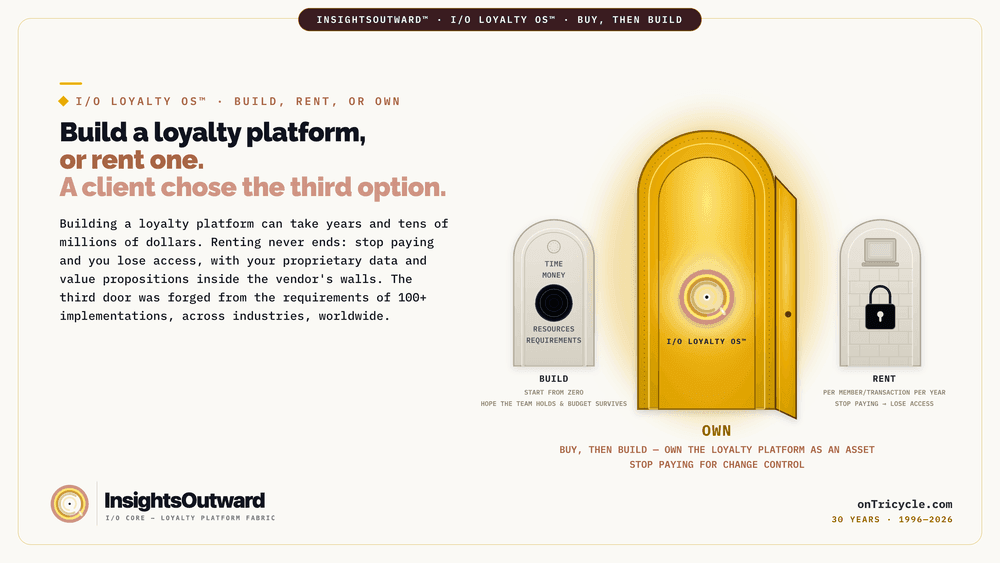
The industry calls it build versus buy. Almost nobody actually buys.
Somewhere right now, a team is running the evaluation everyone runs on loyalty technology: build or buy. Build, and you own it — after however many years and tens of millions of dollars, if the team holds and the budget survives. Buy, and you're live in months.
Except nobody actually buys. “Buy” is the industry's oldest mislabel: you don't buy a SaaS platform, you lease it — per member, per transaction, per year. Run the meter for a decade and check what you own at the end: nothing. The evaluation was never build versus buy. It was build versus rent.
Simplenight chose the option the category had not named.
A year ago this summer, a client bought. Simplenight, the global travel-commerce platform, purchased the source code of InsightsOutward™ outright — not a seat license, not a term subscription with an escape hatch. The platform itself, as an asset on their balance sheet, with an interim license carrying them while their own team ramps. In thirty years of building and selling loyalty technology, I had never signed a contract like it.
I've written about the reasoning before without naming its author. The executive who was tired of putting quarters in the pinball machine — that was Mark Halberstein, Simplenight's CEO. He had run the fork everyone runs — build it, or rent it — and liked neither answer. Years of subscriptions across a stack of vendors and, at the end, nothing on the books to show for it. So he didn't rent the platform. He bought it.
Historically, the only way to own a loyalty platform was to own the company wrapped around it. TSYS bought ESC Loyalty, Merkle bought 500friends, then HelloWorld. I once sat across the table from an issuer exploring the purchase of the loyalty agency I worked for. What they really wanted was the platform under the hood.
The pattern hasn't aged well: one bank just paid $160 million to pull a loyalty company out of bankruptcy to protect its own program; an exchange paid nearly $300 million for loyalty tech that resold last fall for about $11 million. Our answer at Tricycle was simpler. You don't have to buy the company. Buy the thing you actually want.
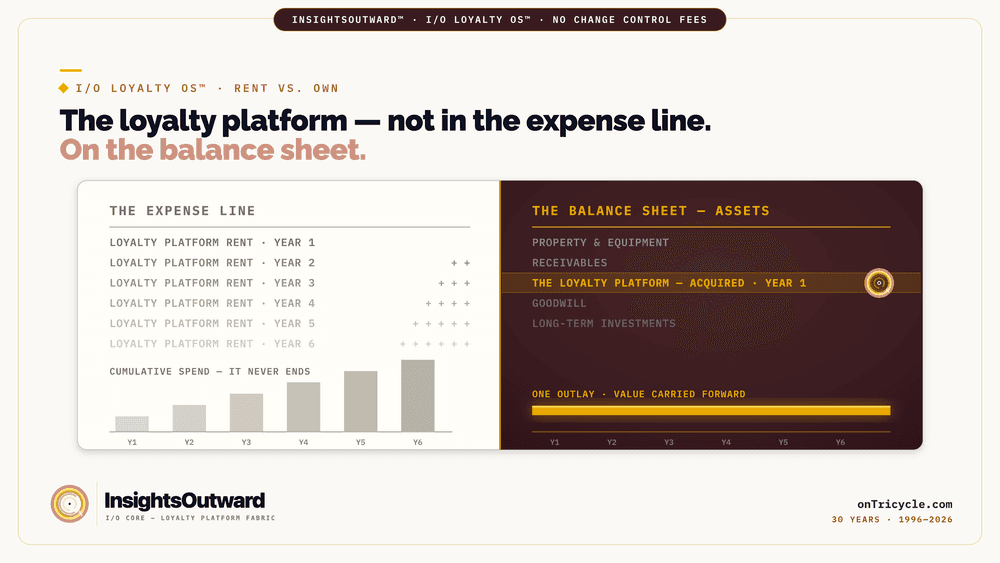
Zero dependency only works when the product contains the whole operating capability.
The conventional wisdom in enterprise software says that's the end of the story. The client owns it now. They can run it without you — that was InsightsOutward's design and operating-model North Star from day one: zero dependency on Tricycle. Why would they ever call again?
Here is what the year since looked like.
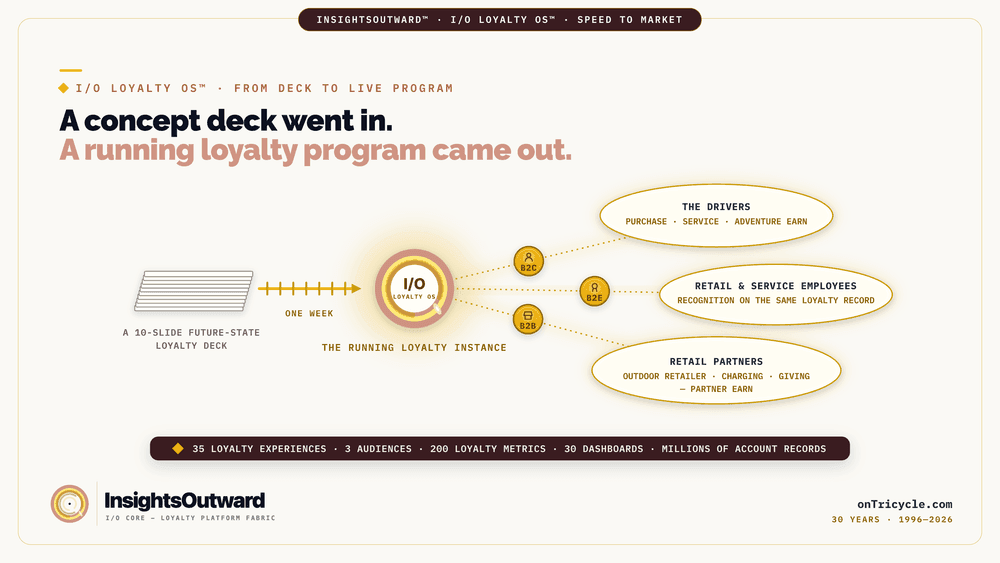
They brought us a global automaker. The vision was encapsulated in ten PowerPoint slides. What existed roughly a week later was not a response deck or an Excel spreadsheet checking boxes of features and capabilities. It was the vision, running: thirty-five distinct loyalty experiences across three audiences — the brand's drivers, its retail partners, and the employees inside its retail and service locations. B2C, B2B, and B2E on one governed instance — the thesis, not as a diagram. In production. The old program mocked into conversion against the new, our What-If engine generating synthetic before-and-after data, accounts and events and transactions, so the room could watch the program work before a single member enrolled. Two hundred metrics. Thirty dashboards. A week.
“The week” is what zero dependency demands. If a client must be able to run the platform without us, then everything loyalty technology does — standing up a program, implementing it, launching it into production, managing it long after — has to be built into the product. Not into a services bench. The completeness is the capability.
Buy, then build: SaaS speed with an asset you own.
What Simplenight signed sits where the industry never had a name: buy, then build. Buy the platform — source code, owned outright, thirty years and a hundred-plus implementations of head start, for a fraction of what a ground-up build costs. Then build on it: your team, your pace, your roadmap — with our maintenance and releases if you want them, without if you don't. Their choice, annually, not ours. And the books treat the two paths differently: a purchased platform is a capital asset that carries value on the balance sheet, while SaaS fees are rent — expensed every year, accruing nothing. Ask your CFO which conversation they'd rather have.
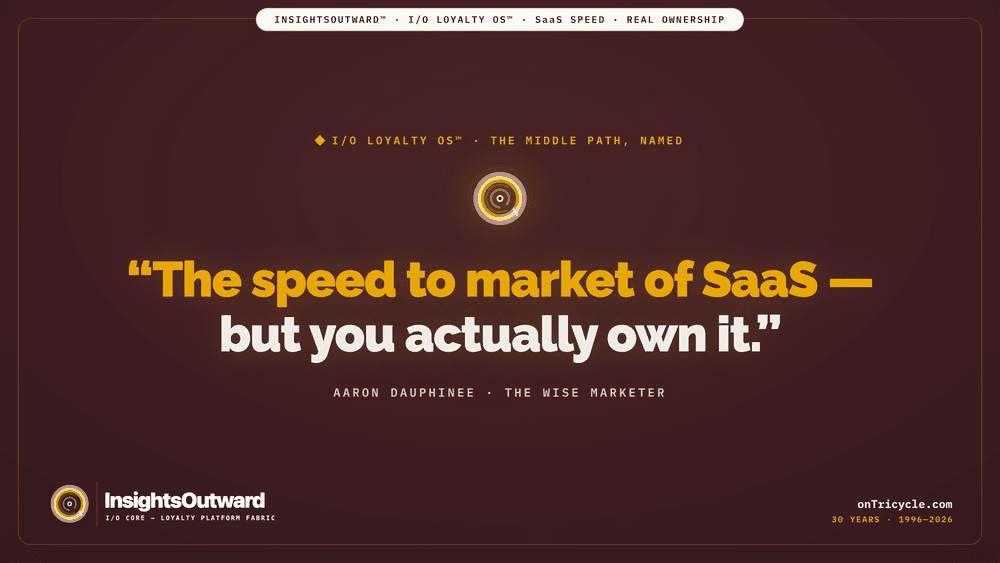
Aaron Dauphinee, CLMP™, of The Wise Marketer, heard the automaker story recently and named the middle path better than we ever had: “the speed to market of SaaS — but you actually own it.”
Ownership turned one client into a route to markets we had never entered.
Then Simplenight kept bringing them. National tourism authorities — a Gulf government and a Caribbean island territory among them. A ministry of sport. A global bank. A second automaker — a European luxury marque. One of the Middle East's largest retail groups. A global manufacturer. And a brewery consortium with the most interesting question we've ever been asked — could we mint a currency indexed to the price of a pint?
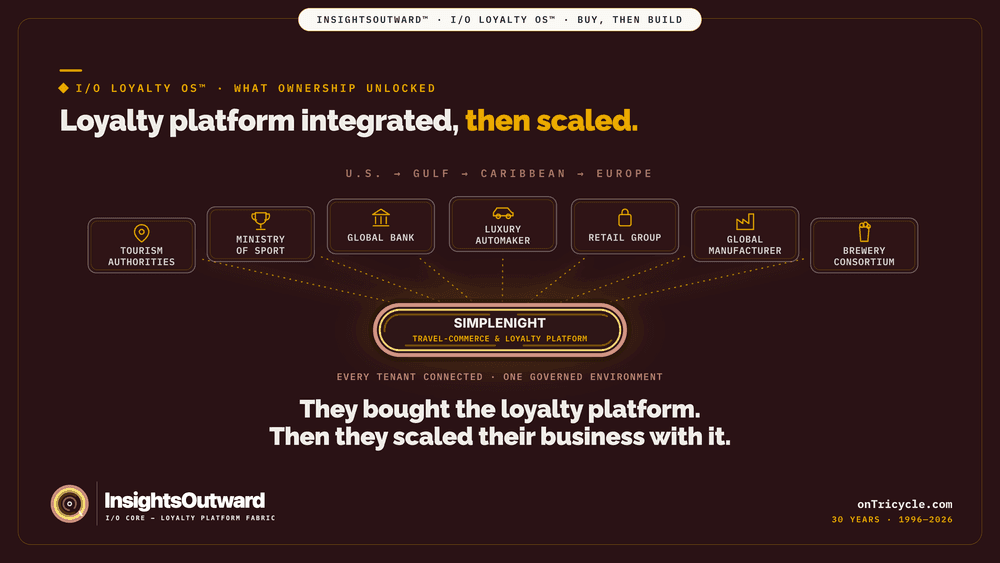
None of these were our leads — not one cold call. Every one walked in through the client who owns the platform.
And underneath all of it sits the architecture: one governed environment, each brand its own tenant — the automaker's program separate from the tourism board's and the brewery's, every tenant on the same ledger discipline. A brand, an agency, a commerce provider, or a network could run loyalty for its entire set of service lines and product capabilities, its entire book of clients, from one owned platform. Different audiences, capabilities, currencies, value propositions, rules, integrations, metrics and insights — all managed in one governed cloud, on one ledger, with no outside agency access. That is not a whiteboard claim. It is Simplenight's ordinary Tuesday.
A client who owns the platform behaves like a stakeholder.
We built the source-code option assuming the benefit was the client's alone. What we underestimated is what ownership does to the relationship. A client who owns the platform doesn't behave like a customer. They behave like a stakeholder. Their success and ours point in the same direction, so they integrate the platform into what they sell, then walk it into rooms we have never been in. It isn't our product, InsightsOutward, they're recommending. It's their capability.
The loyalty industry spends enormous energy on channel strategy — partner programs, referral fees, alliances.
The best channel strategy we ever executed was the central tenet of our design, and a clause in the contract: you can own this, and never need us. No more change control fees. No more outside access and risk to your proprietary data and ideas. Tricycle has happily supported loyalty SaaS for years. InsightsOutward is a Loyalty Platform-as-a-Service. Architecturally.
Simplenight is the proof.
Price the path the category leaves out.
Compare a ground-up build, perpetual software rent, and source-code ownership against the operating model you actually want.
Talk to Tricycle
A practitioner-led conversation about platform economics, ownership, and implementation.
Compare the Paths