Platform-as-a-Service, Not SaaS
A new way to own loyalty. For thirty years, enterprise loyalty was sold one way — you rent it, the vendor owns it. There is another model, inverted: take the platform itself, stand it up in your own environment, and hold the keys.
Most loyalty technology is sold one way. You rent it.
Most loyalty platform technology is sold as SaaS. You rent it. Your loyalty vendor owns the platform, hosts it, runs it on your behalf, maybe hands you a login. It's a sensible model for a lot of things, and it has largely been the only model enterprise loyalty was ever sold under.
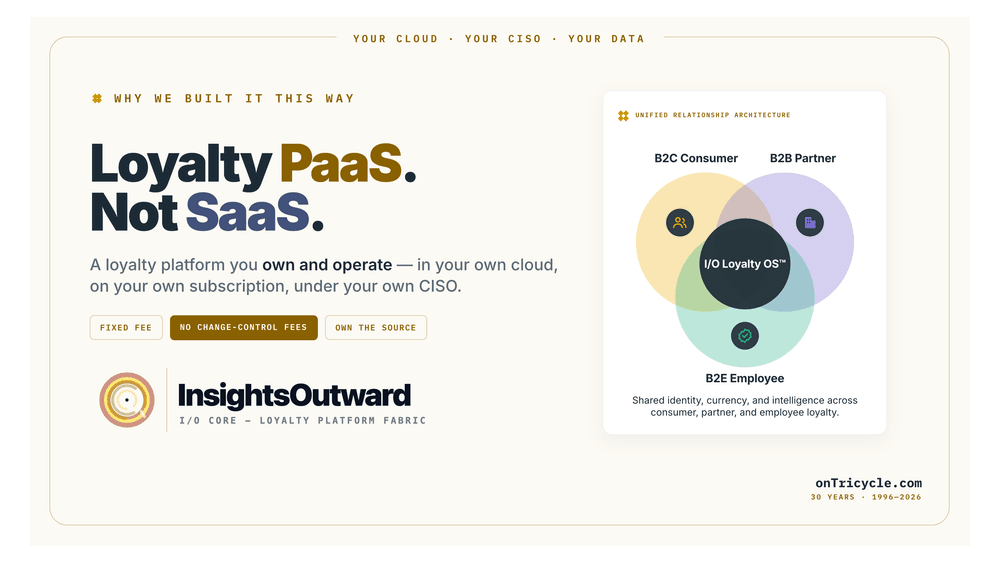
There's another model, less discussed outside engineering circles: Platform as a Service (PaaS). The same idea, inverted. You don't rent the vendor's running instance — you take the platform itself, stand it up in your own environment, and run it with your own people or your own trusted agency relationships, on your own terms. You hold the keys.
For thirty+ years, loyalty was mainly only sold the first way. For the last several, I've been heads-down with Don Hughes and our team, building and implementing loyalty in this new way.
Three decades, 100+ implementations, and the lessons that became the foundation.
Three decades of work, across 100+ implementations of loyalty platforms and programs across industries, across the globe — taught us many lessons, and became the foundation of all the things we wished to do differently, both commercially and through the capabilities of our loyalty platform offering, InsightsOutward:
- Card portfolios with dozens of products under a single issuer, each with its own value proposition for Customers, Employees and Partners — enterprise loyalty is many programs, running at once.
- Bringing points to the point-of-sale at retail scale teaches sub-millisecond response time requirements against complex journeys, experiences and decision rules.
- A loyalty program supporting north of 120+ million accounts teaches what scale actually demands of a platform, globally.
- Programs across languages and geographies and governments — teaches that translation and localization need to be native to the design.
Each one of our previous platforms — at ESC Loyalty, TSYS Loyalty, Kobie Marketing, and at Merkle — was, for its moment, leading-edge. And each one of them was delivered to our clients as SaaS, because that's what the loyalty world had, and how we competed.
The whole arc of that model is familiar to anyone who's lived it.
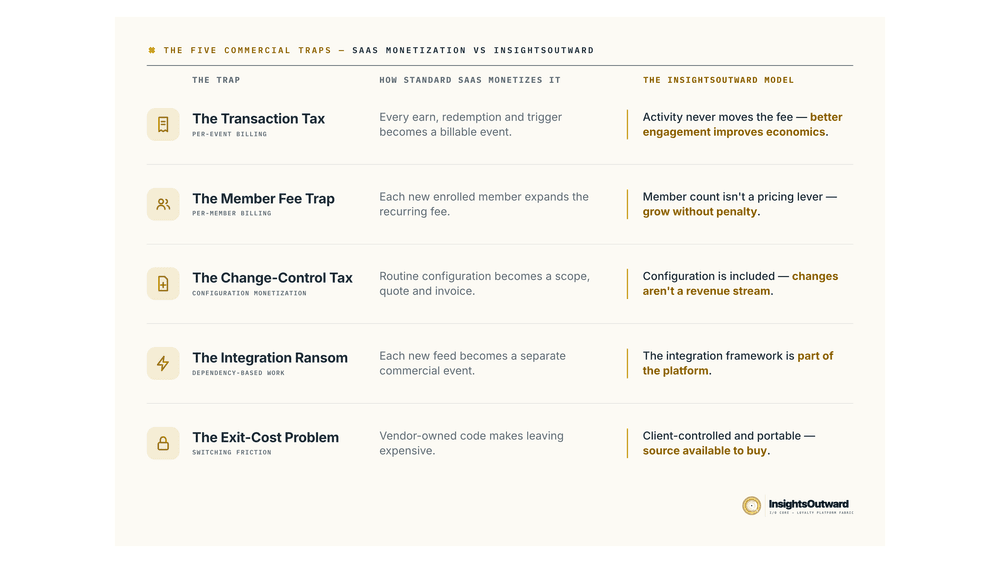
The long and sometimes very costly implementation cycle. Or the conversion off another loyalty vendor's platform that eats the better part of a year and costs a small fortune just to reach production. And then, once you are finally live: the ongoing agency retainer fees, the change-control fees for every adjustment and innovation, an annual license technology expense that climbed with every member and every transaction.
Under SaaS, the better your program performs, the more it costs you to keep it. This dependency isn't a flaw in the model. This dependency was the product.
One decision changed everything we had to build.
When Don first showed me InsightsOutward a few years ago now — version 3.0 at the time — it was clear that this wasn't a 'better points engine.' InsightsOutward supported a different loyalty implementation and delivery model entirely. And there was one decision, one North Star, that impacted the requirements which needed to be supported.
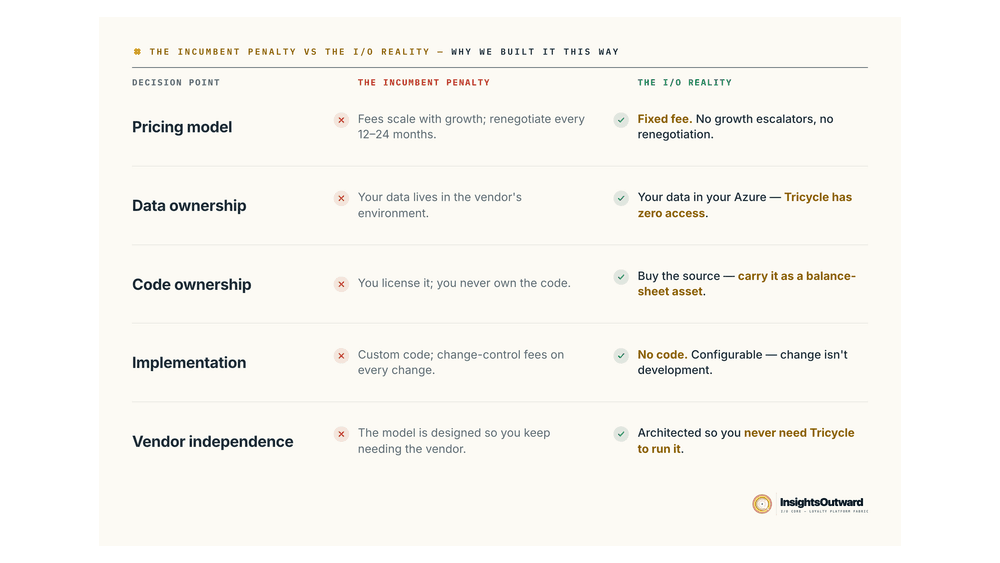
Commercially, we wanted to offer what no loyalty platform or loyalty agency did: not only let a client license the platform at an annual flat, fixed fee — but let our clients buy the source code outright, and own the platform as an asset. And this concept of selling the source code evolved everything we had to include from a capabilities perspective — because if a client can own it, a client has to be able to run it — without needing us. Stand it up, integrate it, configure it, deploy it, govern it, keep innovating — with their own team, or their already trusted IT, digital, and agency partners. If they ever needed to call Tricycle to make it work, it wouldn't really be theirs.
All of my esteemed alma maters, now our competitors, never built for these sets of requirements and to be fair — it isn't that they can't. It's that the SaaS model they run — managing the platform on the client's behalf — doesn't require those capabilities.
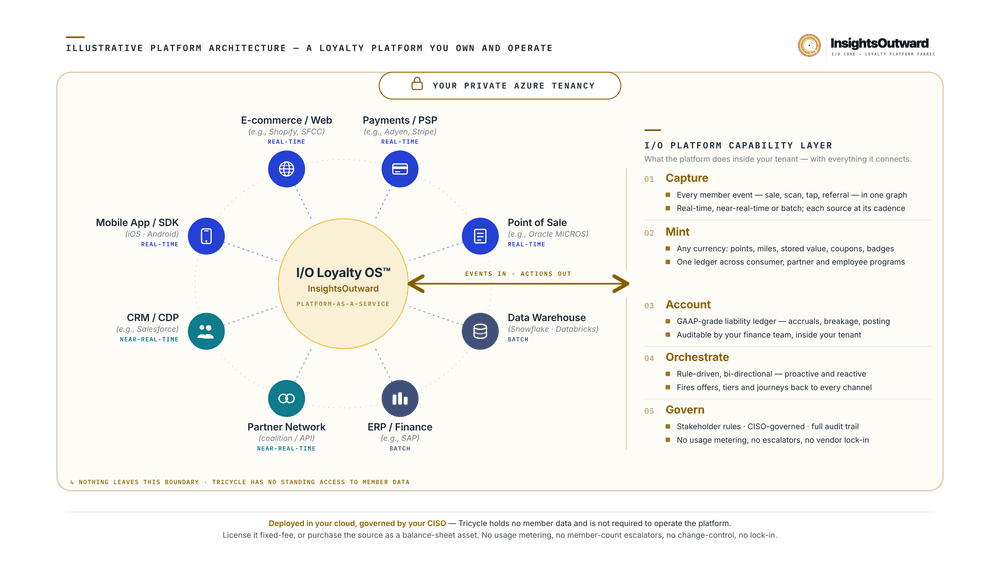
We aimed at an opposite outcome — zero dependency on Tricycle — and it sent us building things you don't find in typical Loyalty SaaS. Yes everyone offers a front-end UI: a journey builder, audience segmentation, a campaign canvas. Table stakes. Almost no one offers the back-end set of capabilities that let a client's own people and teams operate the platform independently, if they so choose.
Offering InsightsOutward as PaaS is where the commercial advantages come from.
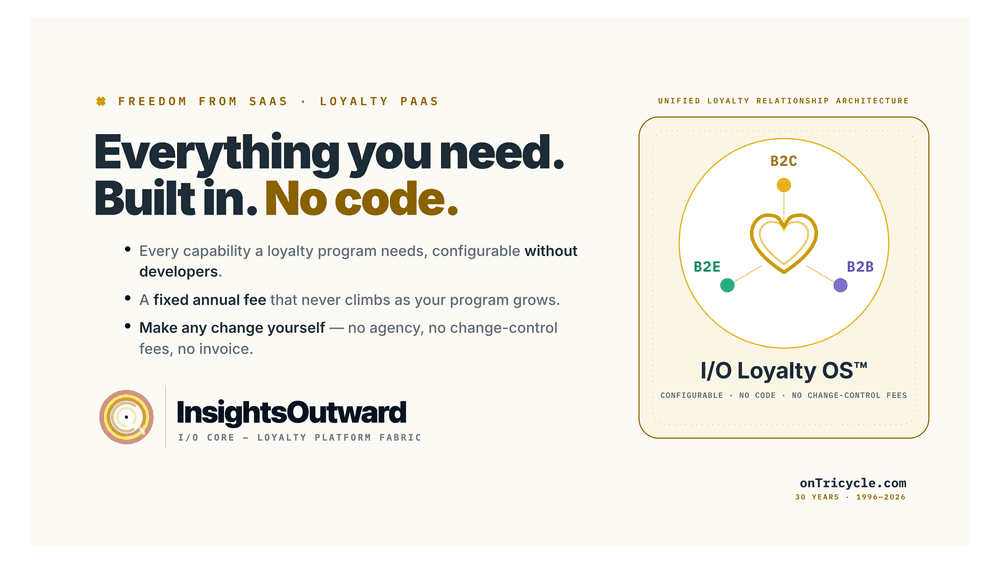
A flat fixed-fee, so your costs don't climb just because your programs grow. B2C, B2B, and B2E value propositions on one instance — consumer, partner, and employee data and events governed through one loyalty architecture instead of three platforms and three contracts. It runs in your cloud, where you control who can reach the environment and the data. Any currency you choose to mint — points, miles, partner value, and one day soon perhaps, AI tokens. A decision engine that works both ways: reacting to what a member does, and being able to act on what they don't.
Shaped by more than 100 enterprise implementations — and outside scrutiny.
All of this shaped by more than a 100+ enterprise loyalty implementations — across retail, financial services, hospitality, travel and tourism, insurance, healthcare, CPG, restaurants, entertainment, telecom, automotive — supporting brands and their programs around the world. Two of the largest global consultancies looked at our technology and reached for the same phrase: a category of one.
We took our time, with purpose, and built from the inputs worth trusting — client and prospect feedback, the lessons from our own history, and comprehensive outside scrutiny. InsightsOutward is on version 10.1 now, and Don and the team are still the architects behind each release. After thirty years of selling loyalty the only way it was sold, we built another way.
One of our first clients bought the source code — and told me why.
And for me, it was profoundly interesting and sort of surprising at the time — one of our first InsightsOutward clients opted to purchase the platform source code, to leverage as an asset on his company's books. Loyalty integrated with his e-comm offerings and services.
He shared with me part of the rationale for his decision — with an analogy to playing pinball. He 'was tired of putting quarters in the machine with no lasting return on the investment.'
Questions about owning your loyalty platform
What is the difference between SaaS and PaaS for an enterprise loyalty platform?
Can a client actually buy the InsightsOutward source code and own the platform outright?
How does the PaaS commercial model change the cost of running a loyalty program?
If we own and run the platform ourselves, what is left for Tricycle to do?
Can InsightsOutward run B2C, B2B, and B2E programs on one instance?
What scale and track record stands behind InsightsOutward?
See What It Looks Like to Own Your Loyalty Platform.
If your loyalty costs climb every time your program succeeds, the problem is the model, not the program. We walk through how InsightsOutward is offered as Platform-as-a-Service — flat fixed-fee licensing, or outright source-code ownership — configured around the systems and cloud you already run.
Request a Live Demonstration
A practitioner-led walkthrough of the platform and the PaaS commercial model against your actual loyalty program economics.
Talk to Us