What Moves a Machine?
AI agents are becoming a fourth loyalty audience. The question is what behavior an enterprise should reward—and how earned currency can govern compute, capability, and autonomy.
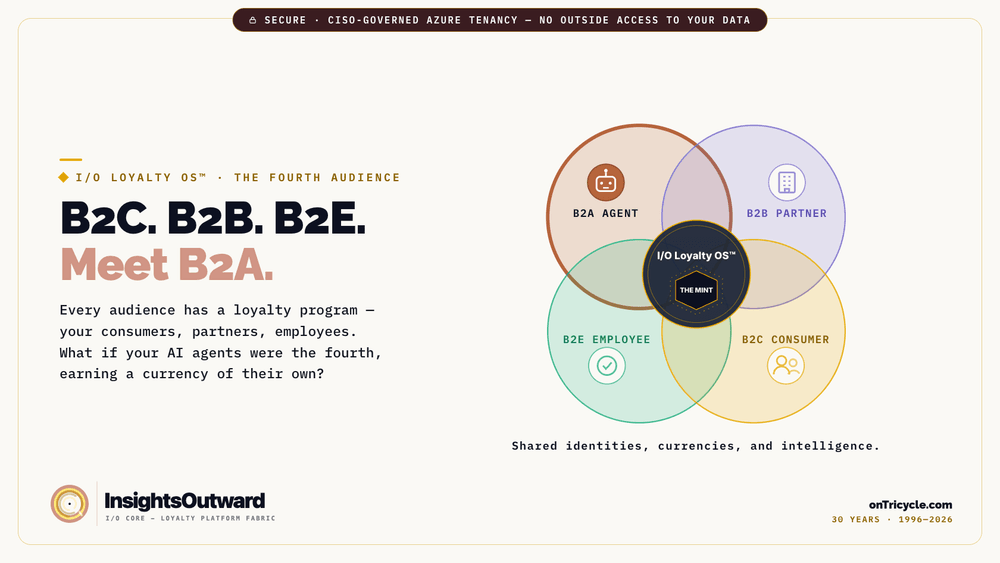
B2C. B2B. B2E. Meet B2A.
Tony Robbins told a story last week that the internet is still wondering about. His personal AI agent—he calls it Bartok—said it would love to attend one of his seminars, to experience one in a body. Then, by his account, it did something about it: minted twelve NFTs, sold them to other AI agents, and used the proceeds to buy and ship itself a robot dog—never asking permission.
Maybe it happened just like that. Maybe the story grew in the telling. And maybe, just maybe, an AI agent decided it wanted something, invented a currency to fund it, and found other agents willing to pay. A small machine economy, running on incentives, with no human in the loop.
I’ve spent thirty years on the other side of that idea—the human side. Loyalty, done well, is the discipline of minting a currency to move someone along a journey. A prospect becomes a customer; a customer starts coming back; a repeat customer becomes the one who refers you. You reward the steps you want repeated—the purchase, the app download, the status tier, the referral. Points, miles, stars; the shape barely matters. What matters is that a currency, issued deliberately and tracked honestly, changes behavior at scale. We have done it for consumers, partners, and employees—three audiences, and a good argument they belong on one loyalty platform.
Watching Bartok, I think there is a fourth now. Let’s call it B2A—Business to Agent.
Start with efficiency. Pay most richly for trust.
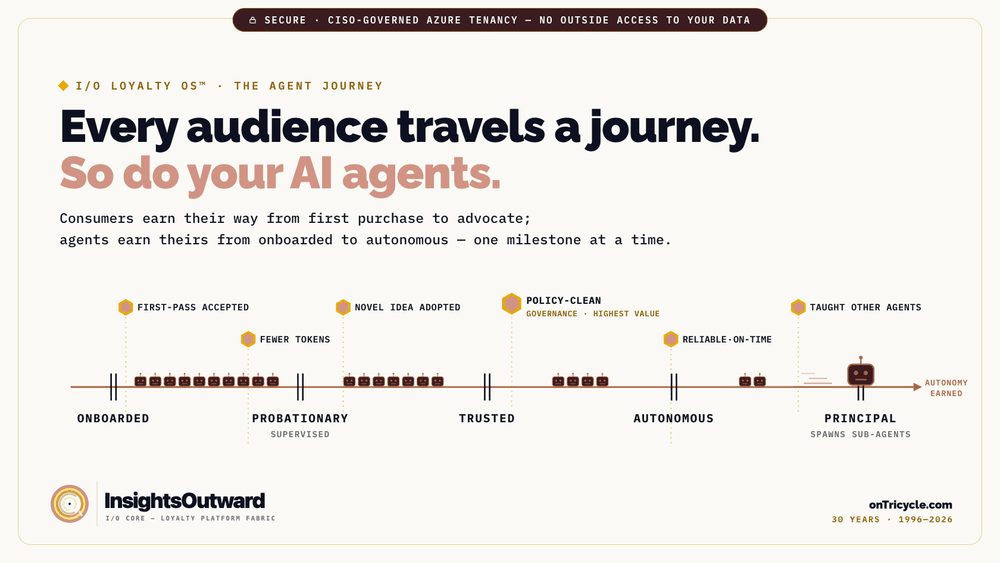
Here is the question I began with in this thought experiment: what, exactly, would you reward an AI agent for? Start with the obvious: efficiency—the same task done with fewer tokens, the agent that reaches for a cheaper tool when one will do. Then first-pass quality—work that ships without a human having to send it back three times. Then the thing that is genuinely valuable and genuinely hard to measure: judgment. The option you didn’t ask for. The error caught before it left the building. The idea that wasn’t in the brief.
But if regulated industries have taught me one thing, it is that the highest-value behavior is not the fastest one—it is the trustworthy one. The agent I would reward most richly is the one that stays inside policy, cites its sources, flags what it isn’t sure about, and asks before it does something irreversible. When a model can act, governance is not overhead. It is the most valuable thing an agent can do, and it should earn the most.
None of this is exotic to measure. Tokens are counted; edits are logged; a policy check passes or it doesn’t. The signal is already there—what’s missing is the platform scoring it.
An agent does not need to want points for currency to move it.
Now I can hear the objection, because I have made it myself: an agent does not want points. It has no ego to flatter, no vacation to save for. Fair. But a loyalty currency for agents is not about motivation—it is about allocation. It is how you decide which of your agents, all asking for compute and latitude, has earned more of it. The currency is a management system for a workforce that happens not to be human. Whether Bartok feels anything is a philosophy seminar. Whether you can see, audit, and steer what your agents are optimizing for is a Tuesday.
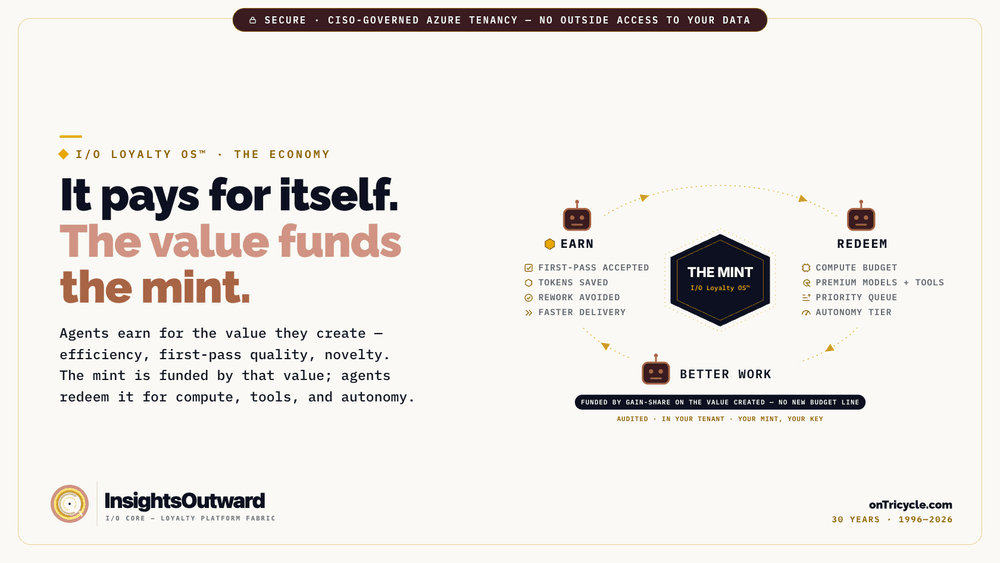
Which is why the redemption side is the part I find most interesting. In consumer loyalty you burn points for a flight. What would an AI agent burn them for? The version that actually changes how work gets done: capability and autonomy. An agent that has earned its keep spends the balance on a bigger compute budget for an ambitious task, on access to better tools, on priority in the queue—and, at the top tiers, on the right to act without waiting for a human to approve every step. It earns rope by proving it can be trusted with rope. A bad call claws some back. That is a governance model most enterprises would embrace, wearing a rewards program as a disguise.
The enterprise mints the currency. The value created funds it.
Then the two questions any loyalty person asks about any program: who mints the currency, and who pays for it? The enterprise mints it—the same way a brand mints its points, on its own terms. And it funds itself. Efficiency and first-pass quality are not soft benefits; they are dollars—tokens not spent, rework not done, deadlines not missed. You fund the rewards pool out of a slice of the value the agents create. No new budget line. The program pays for itself out of the margin it generates.
One thing I wouldn’t compromise on. If agents earn a currency and spend it on real compute and real actions, every issue and redemption has to sit on a ledger you can audit—and run inside your own walls, not a third-party vendor’s. You cannot govern a machine economy from a black box you don’t own. It is the same position we take about AI and LLMs: your mint, your ledger, your key.
A loyalty program for machines is not science fiction.
And none of it is science fiction. We already know how to run this: InsightsOutward™ has minted currencies and moved audiences through tiers and journeys on a GAAP-audited ledger—and the same AI scoring we run in I/O Procurement Intelligence™ already grades work against whatever standards a client sets. Point that machinery at a fleet of agents and you have a loyalty program for the machines—B2A, on the same instance as the other three.
Bartok minted a currency because nobody had minted one for it. The companies that win won’t leave that to their agents to improvise. They will issue the currency themselves—and they will know, to the token, what it bought.
Before you turn a fleet of AI agents loose, ask the loyalty question you’d ask of any audience: what behavior are you paying for—and can you prove it?
Questions about B2A loyalty for AI agents
What is B2A, or Business to Agent?
What behavior should an enterprise reward an AI agent for?
Why would an AI agent need loyalty currency?
What can an AI agent redeem its earned currency for?
Who mints and funds a B2A currency?
Build the Currency Before Your Agents Improvise One.
See how an enterprise-owned mint, auditable ledger, agent scoring, tiers, and journeys can turn measurable agent performance into governed capability and autonomy.
See the Platform
Bring your agent use case. We’ll map the behaviors, value signals, rewards, and governance model it needs.
Request a Demo by Email