A Walled Garden Locks You In. Sovereignty Locks Us Out.
Two of the most consequential voices in enterprise software have described the same architecture: own the learning loop, or the advantage compounds for someone else. It is the architecture InsightsOutward™ was built on.
The enterprise pays twice.
Satya Nadella's argument: AI inverts the information paradox. The enterprise pays twice — once in currency, again in the proprietary know-how it must reveal for the model to be useful. Prompts, corrections, workflows, and evaluations become training exhaust, and that exhaust accrues to whoever owns the learning infrastructure. Model sovereignty is the least discussed and most consequential question in enterprise AI.
Alex Karp's argument, more directly: own the compute, the data, and the models, or the advantage compounds for someone else. Controlling the weights is controlling the outcome.
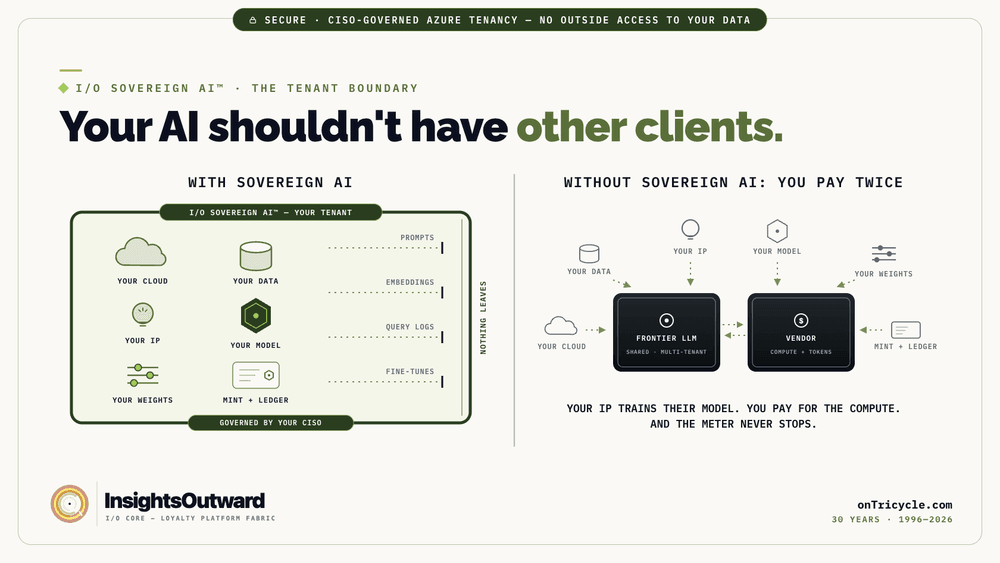
Weights are the form in which AI knowledge can be owned.
A note on weights, because the term carries the argument. A model is a vast field of numbers — the weights — adjusted through training until the model performs. Everything the model knows is dissolved into them.
The consequence: the transfer is irreversible. Proprietary knowledge does not sit inside a shared model as a retrievable copy that can be deleted on request. It has been distributed across billions of parameters and cannot be extracted.
Data are the recipes; weights are the trained chef's instincts. Recipes that trained another party's chef cannot be recalled — and that chef now cooks for the competition.
Weights are also the only form in which AI knowledge can be owned. An insight cannot be owned. A weight can.
The claim is not novel to us. It is the specification we built to.
Sovereignty, defined operationally: every AI capability InsightsOutward™ runs is deployed inside the client's own cloud subscription. Tricycle holds no key. No prompt, embedding, query log, or fine-tune crosses the tenant boundary.
The client's model learns from the client's data and nothing else — and no other client's model learns from theirs. The intelligence compounds inside the walls rather than leaking out of them.
The same architecture governs creative, loyalty, and procurement intelligence.
Studios. Sage scores every creative asset before a human reviewer sees it — clarity, engagement, brand adherence, and the regulatory standards governing the client's category. Scrutiny moves to the front of the process, so the rework loop contracts. The model learns the client's standards and teaches them to no one.
I/O Loyalty OS™. Two-way AI decisioning runs inline with real-world events. The decision logic is entirely the client's: if a consumer presents this pattern, act; if a partner does this, act; if an employee does not do this, act. InsightsOutward™ is agnostic to the rule by design — the architecture ensures Tricycle cannot see it.
I/O Procurement Intelligence™. Natural-language queries across an entire integrated agency portfolio — vendor performance, rework cost, brief bottlenecks, consolidation scenarios — are answered against live records, inside the client's environment.
The AI decides. The platform acts. The ledger records.
The platform closes the loop in both directions. Events are published to the client's AI across a three-speed fabric — real-time at the point of sale, near-real-time from CRM and HRIS, batch from the data lake. The AI's calculation returns, and the platform executes it against the account: currency minted, a partner incentive issued, an employee achievement recorded.
Those actions land on the GAAP-audited ledger, in milliseconds, via the native decision engine and experience-design templates. A member's spend falls below pattern and the model issues a targeted multiplier rather than a blanket discount. A distributor sits three days short of a volume tier and the model issues a rebate sized to close the gap. A certification is about to lapse and the model issues learning credits ahead of the exception.
One mint, one ledger, three audiences, one instance.
A walled garden locks the customer in. Sovereignty locks the vendor out.
Is this a walled garden? It is the inverse — and the distinction is an old argument arriving at a new layer of the stack.
The SaaS loyalty platform is itself a walled garden: multi-tenant, vendor-hosted, the client's data resident in the vendor's cloud. The client owns that data contractually and is locked out of it operationally — unable to stand the platform up, unable to change a rule without a change-control fee, unable to leave without a migration measured in years and millions.
The meter runs on success: per member, per transaction, per point issued. Substitute tokens for members and fine-tuning for change control, and it is the same architecture.
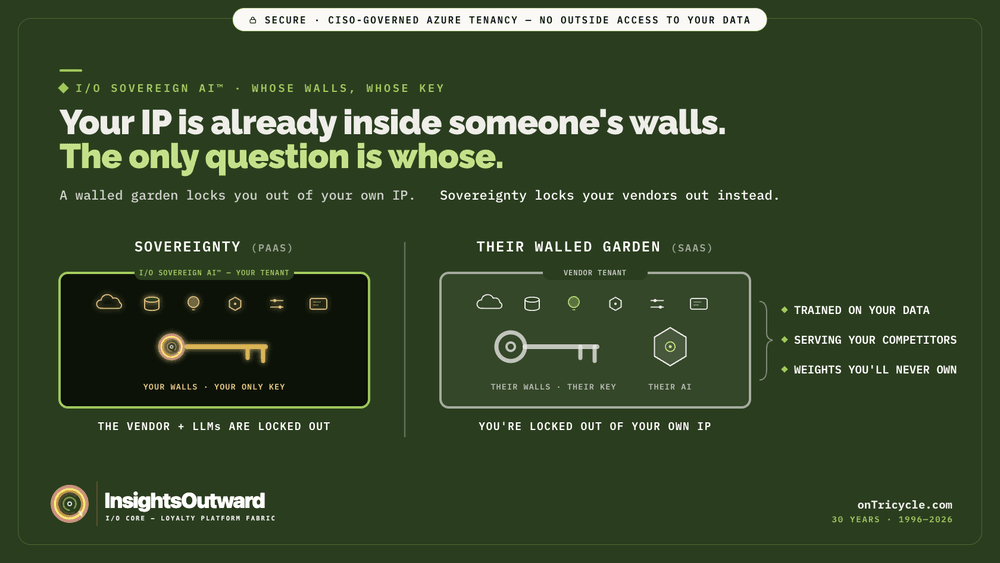
InsightsOutward was built to be the opposite of the SaaS loyalty model.
Tricycle's leadership spent three decades inside that model — running SaaS loyalty platforms at ESC, TSYS, Kobie, and Merkle. InsightsOutward™ was built to be its opposite.
One difference matters. SaaS lock-in is reversible — expensively, but reversible. Weight capture is not. A platform can be migrated away from. A model cannot be un-taught.
The client owns the environment, holds the only key, and may exit with everything — configuration, data, model, and the source code itself, purchasable outright as a balance-sheet asset. InsightsOutward™ is licensed at a flat annual fee that does not escalate with scale, or purchased outright.
Sovereignty and metering cannot coexist: a vendor that profits from your dependence will architect for your dependence.
Two questions settle the architecture.
Before evaluating any AI architecture, two questions settle it: when your data enters this model, does it ever leave — and who else may query what it learned?
Sovereign by architecture. Not by promise.
Questions about tenant-isolated enterprise AI
What does sovereign AI mean in InsightsOutward?
How is sovereignty different from a walled garden?
Why do model weights matter?
How does this architecture apply to I/O Loyalty OS™?
Can sovereignty and metered pricing coexist?
Find Out Where Your AI Learning Loop Actually Lives.
If your AI vendor owns the environment, meter, key, and model improvement loop, your enterprise value is leaving through the architecture. We can walk through how InsightsOutward keeps AI decisioning, loyalty economics, and procurement intelligence inside your own tenant boundary.
Map the Boundary
A practitioner-led architecture review of what leaves, what learns, who holds the key, and what you can take with you.
Talk to Us