Everyone Says “Loyalty Reimagined.” Almost No One Shows You.
Point loyalty technology at the least loyalty-shaped business you can find and its real purpose becomes clearer: measure behavior, score it, and move it.
“Loyalty reimagined” has become wallpaper.
Search “loyalty reimagined.” It’s a report title from two different firms this year. It’s the header on half the decks at conferences. It seems to be one of the most repeated and least explained phrases in my field — everyone says it, and almost no one tells you what it actually means. A friend in loyalty put that to me plainly last week, and he’s right: the phrase has become wallpaper. So here is an example of what loyalty reimagined means — explained by pointing loyalty platform technology at the least loyalty-shaped business I could find.
The trick is to ignore what a technology is supposedly for and ask what it actually does. Strip a loyalty platform of the points and the branding and it’s one thing: an engine that measures behavior, scores it, and moves it. Which raises a better question than “who has a rewards program?” It’s “where is there a business full of behavior nobody is measuring?”
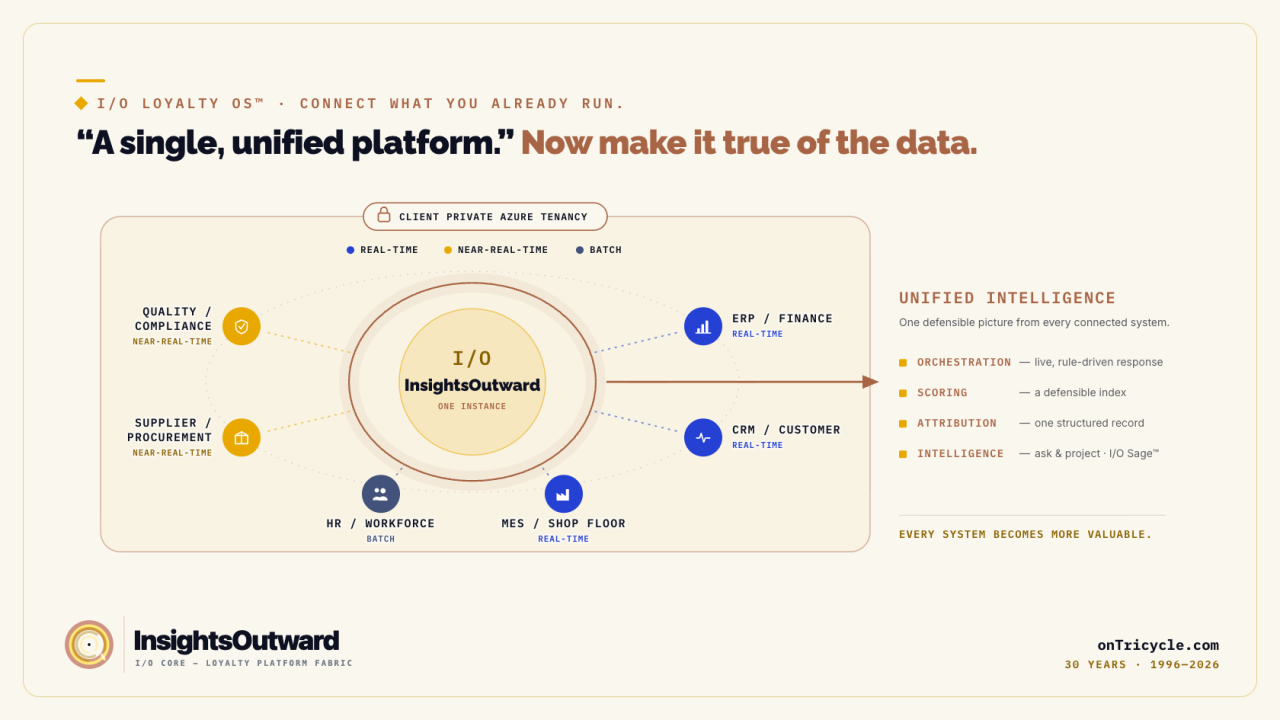
Point the loyalty engine at a value chain instead of a checkout.
With that thought in mind, a LinkedIn post from a friend in manufacturing caught my eye, and so I took a look at his business and industry: regulated contract manufacturing.
- Complex electronics for aerospace, defense, and medical.
- No consumers.
- No app, no points, nothing a loyalty vendor would ever call a prospect.
- By the old definition, there’s nothing to do here.
But then I looked closer at what they do and how they do it. They live or die by a supplier base — components run 50 to 70% of revenue. They run on a skilled workforce where a defect or a departure is expensive. They hold OEM customers on multi-year contracts with brutal switching costs. And humming across all of it is a dozen disconnected systems — ERP, shop-floor, quality, procurement, CRM — each throwing off data nobody connects, or thought to turn into accretive value. That’s not the absence of a loyalty program. That’s a value chain thick with relationships and completely uninstrumented.
What would you do? Point the engine at the chain instead of a checkout. Every relationship in it can be tracked, scored, and moved — the same three moves a loyalty platform makes on a consumer, now aimed at suppliers (score reliability, lead time, quality, and let volume follow performance), the workforce (recognize safety, defect-free runs, tenure), and customers (score account health and intervene before a renewal goes quiet).
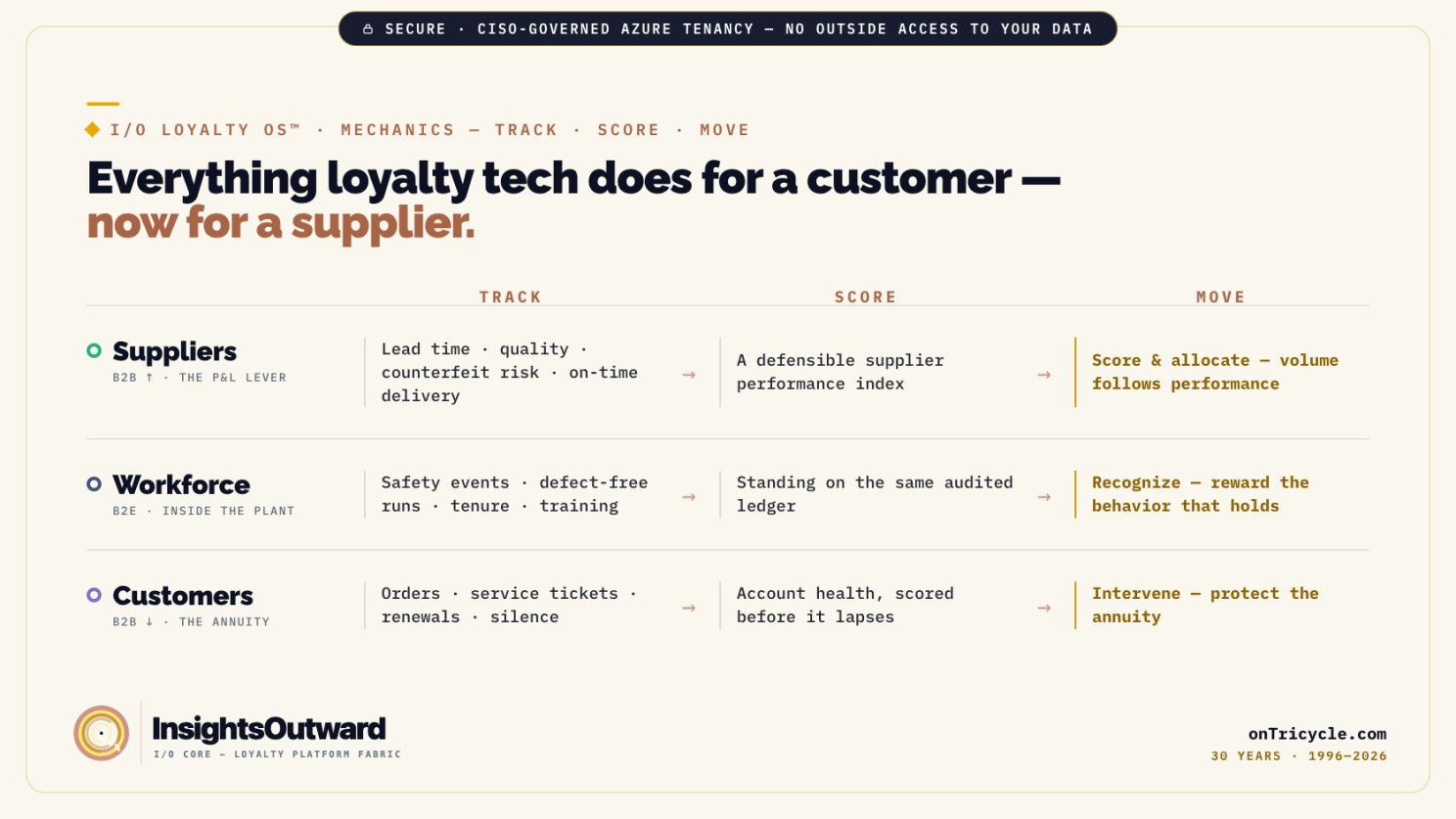
Connect what they already run. Turn the exhaust into one defensible picture.
How would you do it? This is the part that matters, and it’s the opposite of a rip-and-replace. You don’t tear out their systems — you connect the ones they already run into a single I/O Loyalty OS™ instance, read each at the speed it supports, and turn the exhaust into one defensible picture. Every good manufacturer already describes itself as “specialized capabilities integrated into a single, unified platform.” It’s true of the org chart. It’s almost never true of the data. You make it true of the data. No system is replaced; every system becomes more valuable.
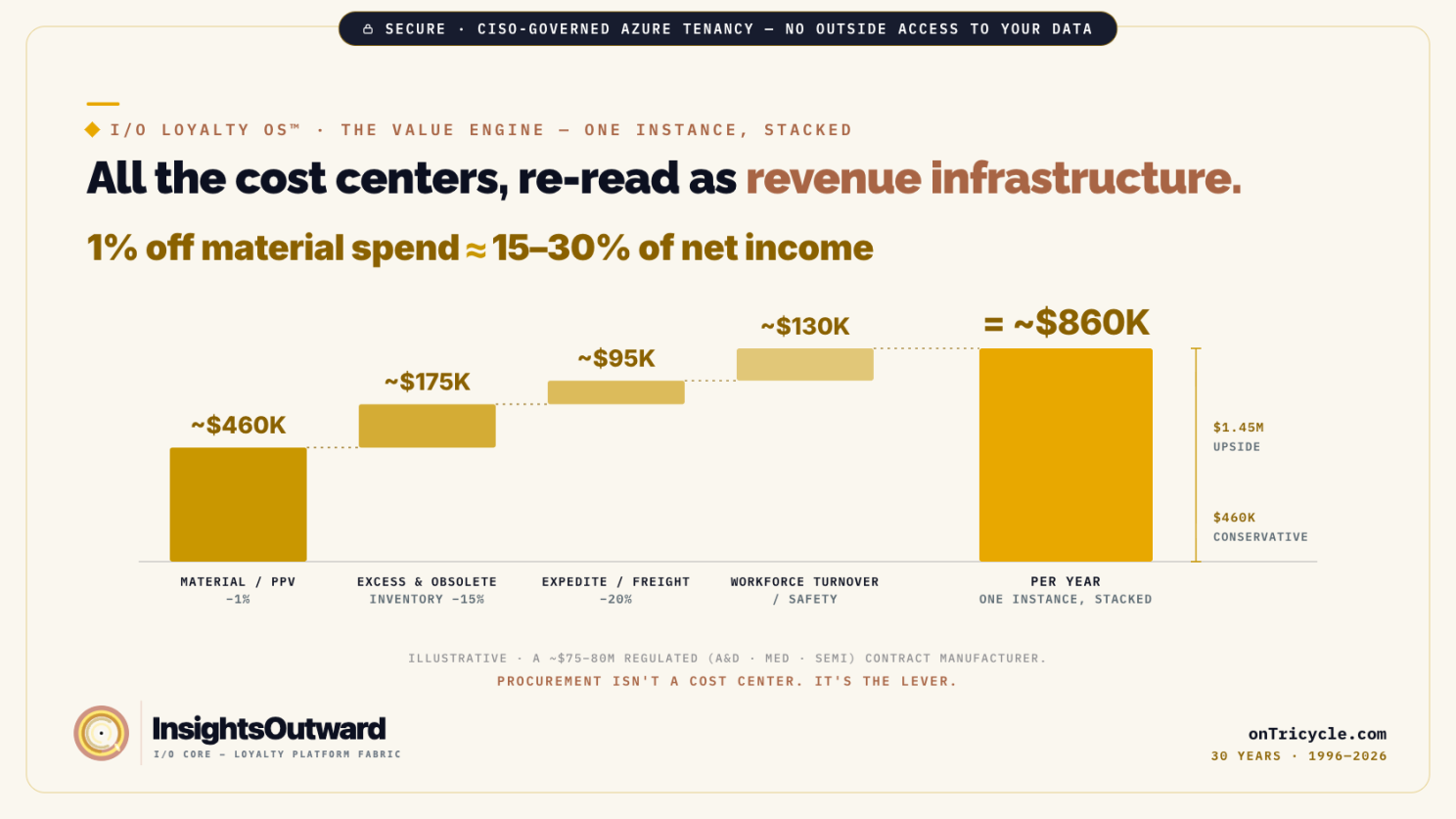
Why would you do it? Because in a materials-heavy, thin-margin business, the leverage is violent. One percent shaved off material spend is worth 15 to 30% of net income. Procurement stops being a cost center and becomes the lever. Turnover and safety cost real money. A retained annuity account is worth more than any new logo. These aren’t soft engagement metrics — they’re the P&L.
What would the outcomes be? Stack the levers on a mid-sized manufacturer — procurement, inventory, freight, workforce — and the modeled value lands near $860,000 a year, on a band of roughly $460K to $1.45M.
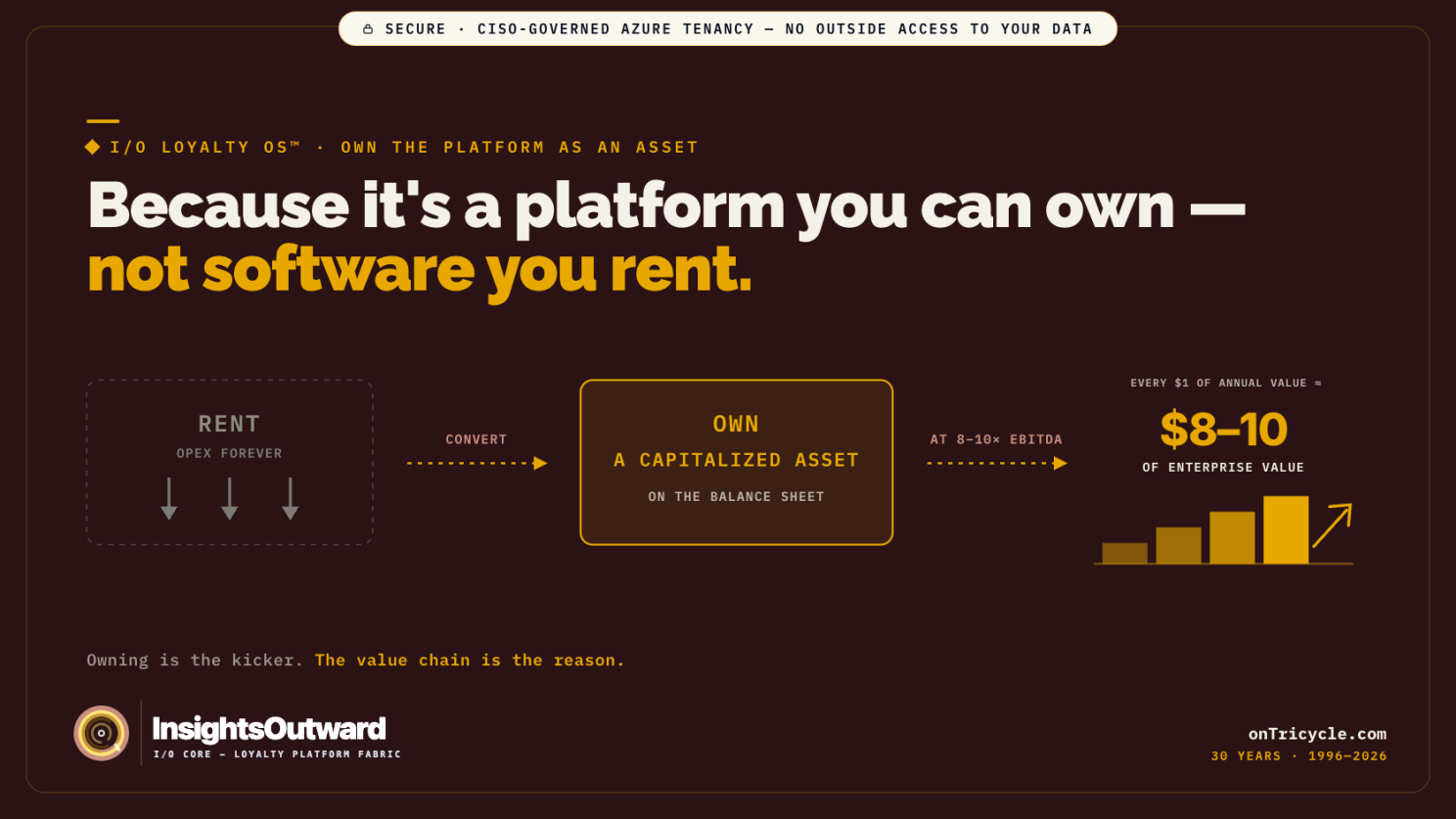
Owning is the kicker. The value chain is the reason.
Because what we’ve built is a platform you can own, you carry it as a capitalized asset instead of a rented line — legacy SaaS — and for a PE-backed owner, that lifts the number the business sells on. Owning is the kicker. The value chain is the reason.
That — as far out there as this use case may seem to be — is what “loyalty reimagined” actually looks like when you implement it in an industry that never knew loyalty platform technology existed. This has nothing to do with “loyalty” on the face of it. The reimagining isn’t a new rewards mechanic; it’s realizing the loyalty engine was never just about rewards.
Where else does this belong that none of us have pointed it at yet?
The more interesting question to me, given what we’re seeing in brands and industries adopting loyalty technology for use cases that have nothing to do with traditional loyalty: where else does this belong that none of us have pointed it at yet?
We found the RFP from one of our clients and flipped the script. I invented the use case involving the factory floor, and am about to go present it to my friend to see if I’m crazy.
And all of this leaves me wondering — what are all the other use cases and brands and industries where loyalty platform technology can help transform cost centers into revenue infrastructure? If that was the game, where would you tell me to aim it?
Point the Engine at Your Value Chain.
Bring us the relationships, behaviors, and disconnected systems inside your business. We’ll map what can be tracked, scored, and moved — without replacing the systems you already run.
Bring Us the Use Case
See how InsightsOutward can connect your existing data and turn under-instrumented relationships into measurable value.
Request a Demo by Email