Loyalty Currency, Value Optional
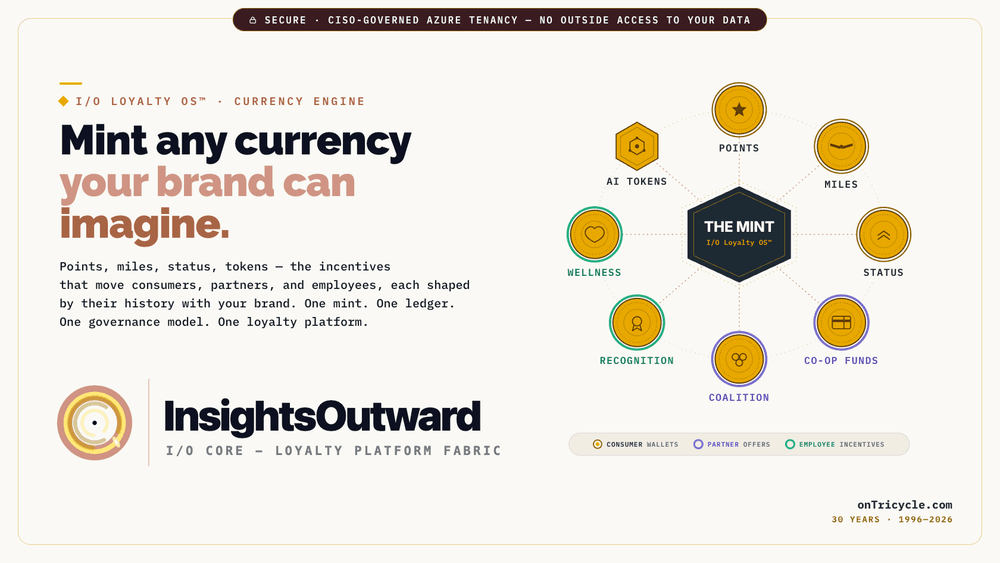
A CRM remembers a customer. A CDP describes one. A campaign tool messages one. A loyalty platform inspires one — in part, by minting currency. That single act is what separates loyalty from the rest of the marketing stack, and the range of what a platform should be able to mint runs well past points and miles.
A loyalty platform inspires a customer, in part, by minting currency.
A CRM remembers a customer. A CDP describes one. A campaign tool messages one. A loyalty platform inspires one, in part, by minting currency — points, miles, and the like — along the customer, partner, and employee journeys.
That capability — creating a unit of value, accounting for every unit in existence, governing how it is earned and spent, and letting it be redeemed — belongs to loyalty technology. It is the defining act of a loyalty platform, and the capability that separates loyalty from the rest of the marketing stack. The distinction is structural, and the range of what a loyalty platform should be able to mint runs well past points and miles.
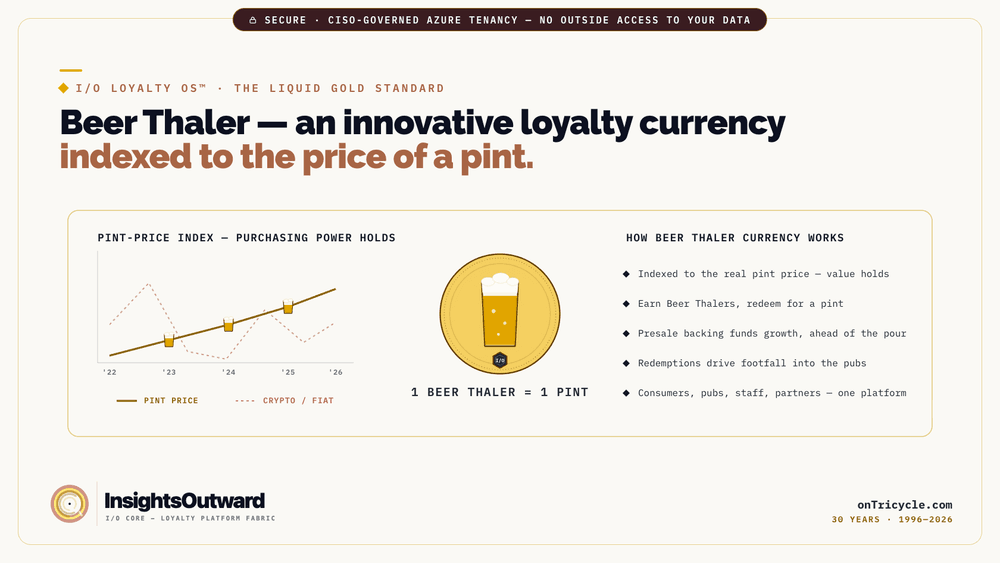
A currency where one unit is worth one pint — indexed to the price of the pint.
Consider one of the most innovative currencies InsightsOutward™ has been asked to evaluate. A European brewery consortium posed a question the team had not seen before: could the platform mint a currency where one unit is worth one local pint, indexed to the real price of that pint?
They called it the Liquid Gold Standard — a credit that preserves beer-purchasing power by tracking pint prices upward, rather than eroding like a fiat-pegged stablecoin or swinging like crypto. It would be issued two ways: to pre-sell pints to fund expansion, and to reward loyalty — both under a conservative issuance guardrail, with consumer, trade-partner, and employee value running simultaneously on one instance, every issuance and redemption on a GAAP-audited ledger. A modern thaler — the silver coin that gave the word "dollar" its name — minted with loyalty software.
The lesson is not the beer. A currency backed by a pint generalizes to a currency backed by anything.
The lesson is not the beer. It is that a currency backed by a pint generalizes to a currency backed by anything. The lifecycle is constant: capture the event, mint the unit, account for it on a GAAP-audited ledger, govern how it moves.
InsightsOutward™ runs that lifecycle — Capture, Mint, Account, Govern — for points, miles, cashback, partner value, stored value, and hybrids not yet named, across B2C, B2B, and B2E programs on a single instance and one governance model.
Capture the event. Mint the unit. Account for it on a GAAP-audited ledger. Govern how it moves. The lifecycle is constant — only the currency changes.
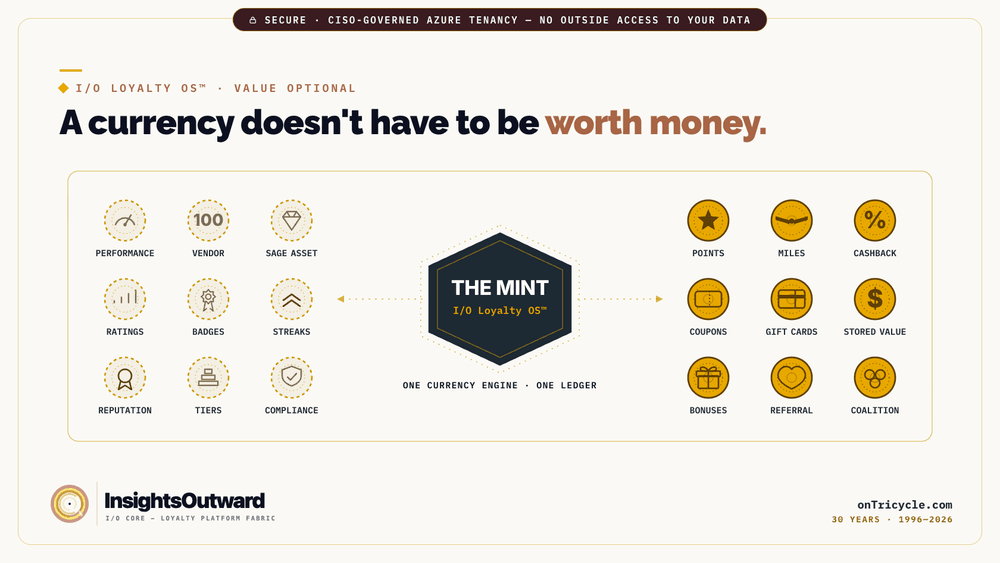
The deeper differentiator: a currency does not require monetary value.
Badges, ratings, and scores are currencies in every structural sense: minted on an event, held in an account, governed by rules, tracked over time — yet they are worth nothing, in dollars, by design. That property is what lets the same engine that runs a consumer points program govern something that looks nothing like one.
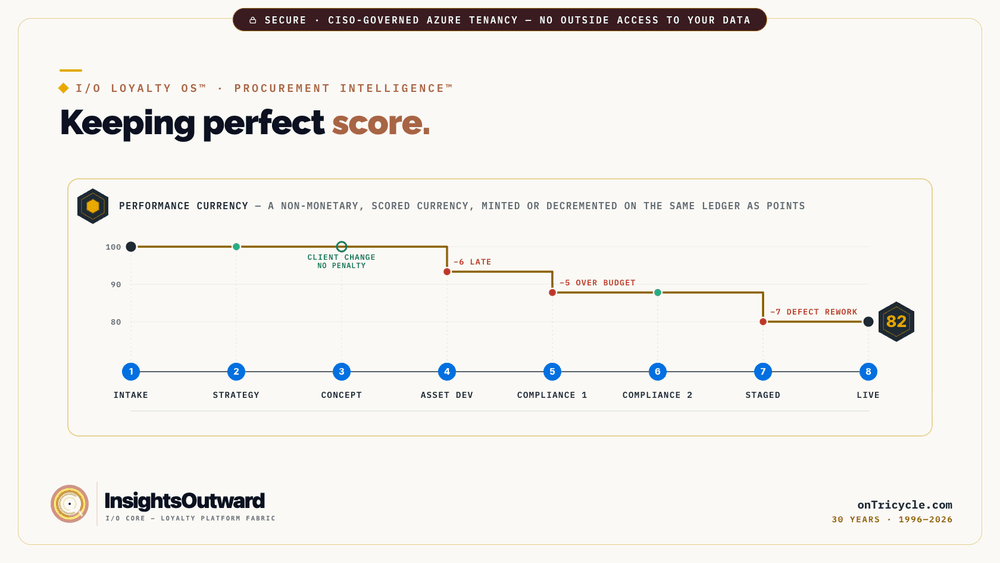
Point the same mint at the agencies you pay, and the currency tracks performance.
Pointed at the relationship between a company and the agencies it pays, the engine becomes I/O Procurement Intelligence™. The mint, the ledger, and the governance are identical; the currency is a performance currency. Scoring is fully configurable — start at zero and increment, or start at one hundred and decrement.
In the demonstrated procurement model, each vendor began at 100 across the scoring dimensions and was decremented for work that missed — not on time, not on budget, or rework caused by a defect. Rework caused by client change-control does not impact the agency's score. The platform clocks on and off through every stage, so the result is not a quarterly opinion but a running balance, minted and burned event by event, on the same audited ledger that governs consumer points.
A running balance, not a quarterly opinion — minted and burned event by event, on the same audited ledger that governs consumer points.
A complete engine should anticipate, not only react.
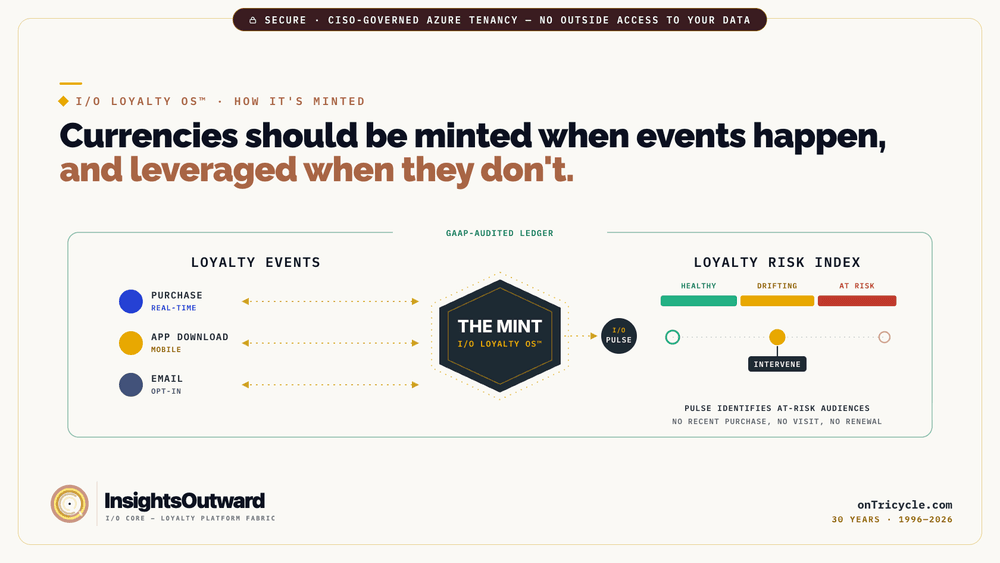
InsightsOutward™ issues and decrements value in response to real-world events across a three-speed fabric — real-time at the point of sale, near-real-time from CRM and HRIS, batch from the data lake, or the credit-card processor statement files.
I/O Pulse, the proactive half of the InsightsOutward decision engine, does the inverse: it monitors for the event that did not occur — no purchase, no visit, no renewal — and mints an audience and a value proposition to intervene before the relationship drifts from green to yellow to red. Currency that responds both to what a member does, and what a member does not.
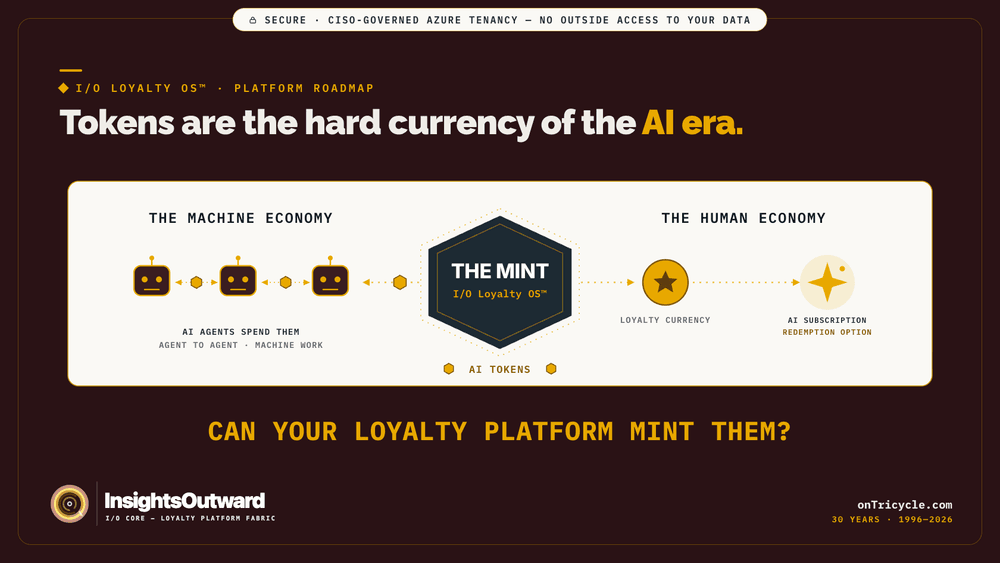
As AI agents transact, tokens are becoming the hard currency of the AI era. Can your platform mint them?
Our collective horizon now includes tokens — as AI agents transact, tokens are becoming the hard currency of the AI era. One relevant question for any loyalty technology provider: can its platform mint them? None of us in this space can yet mint a token that an autonomous agent will ultimately spend, InsightsOutward™ included.
Yet the operating layer that future capability requires is not blockchain novelty; it is controlled issuance, immutable accounting, and defensible governance — the same capabilities already minting points and pint-indexed thalers today.
The discipline will outlast the novelty.
Most platforms mint points. InsightsOutward mints a currency system.
Most platforms mint points. InsightsOutward™ mints a currency system: value optional, audience-agnostic, audited, and owned by the client.
The difference is architectural.
Questions about what a loyalty platform actually mints
What does it mean for a loyalty platform to "mint" a currency?
What is the Liquid Gold Standard, or a pint-indexed loyalty currency?
Can a loyalty currency have no monetary value?
How does I/O Procurement Intelligence use the same currency engine?
What is I/O Pulse, and how does it mint currency for events that did not happen?
Can InsightsOutward mint AI tokens?
See What a Currency System Looks Like When You Own the Mint.
If your platform can only mint points, it is doing a fraction of what loyalty technology is for. We walk through how InsightsOutward runs one lifecycle — Capture, Mint, Account, Govern — for points, miles, stored value, pint-indexed thalers, performance scores, and value-optional currencies, across B2C, B2B, and B2E programs on a single instance and one audited ledger.
Bring Us a Currency
A practitioner-led walkthrough of how InsightsOutward would capture, mint, account for, and govern the currency your program actually needs — monetary or not.
Talk to Us