The Bench vs. the Network
There is a phrase inside holding-company and large-agency creative that quietly explains your rate card: the bench. AI is about to change what it costs — and who pays for it. Tricycle Studios was built on the opposite structure, in 1996, long before any of this was a headline.
A phrase inside holding-company creative quietly explains your rate card.
There is a phrase inside holding-company and large agency creative that quietly explains your rate card: the bench.
The bench is the roster of people staffed between projects — creatives, producers, strategists, project managers — held against work that might arrive, and billed one way or another into the work that did arrive. Clients pay for the bench. It is included in the rate card, and the billing agency's margin on the work accounts for it. One could say that for thirty years, this was simply the cost of getting regulated creative made.
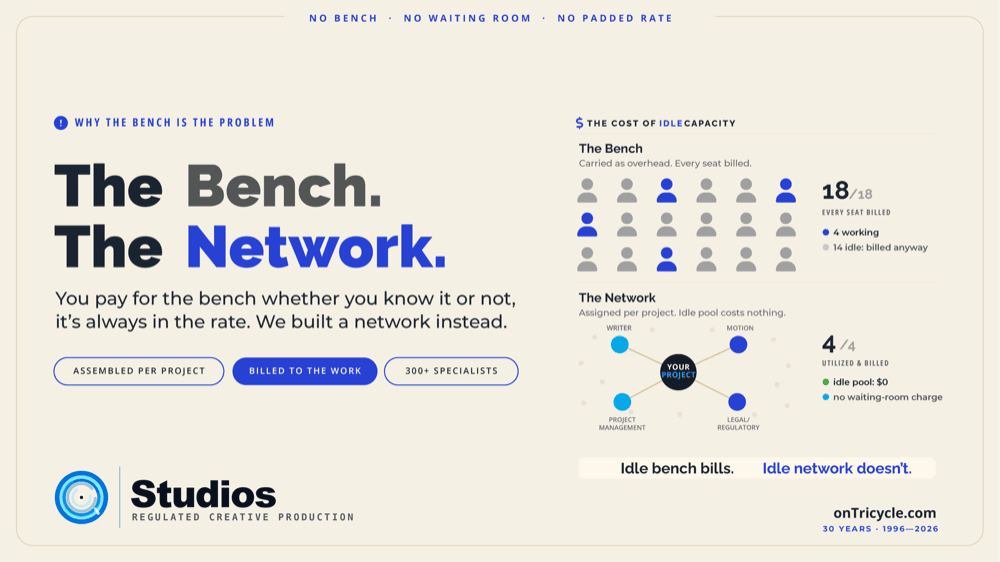
AI changes what the bench means — and what it costs.
Today, AI — and how AI is leveraged for client delivery — naturally changes what the bench means, and costs. A model built on billable hours now faces a technology that makes a meaningful share of those hours unbillable: faster comps, faster localization, faster versioning, faster delivery.
A company organized around the bench, and wishing to protect its billable hours and margin, has one rational response to that: protect the roster, and slow-walk the efficiency its clients are asking for — because the efficiency is pointed straight at its own cost structure.
This incentive is not malicious. It is structural. And the client pays for it either way.
Tricycle Studios was built on the opposing structure — in 1996.
Studios is not a bench — it is a network: 300+ vetted specialists across the full spectrum of regulated creative, assembled onto the specific project that needs them. A purpose-built team of experts, incented to deliver efficiently, and effectively. There is no waiting room in the rate.
A pharma launch that needs a copywriter fluent in MLR intricacies, a graphics and motion designer, a video producer, and localization across twenty-nine languages gets exactly that team — without a standing in-country office and its associated overhead in each market. When the project changes, the team changes.
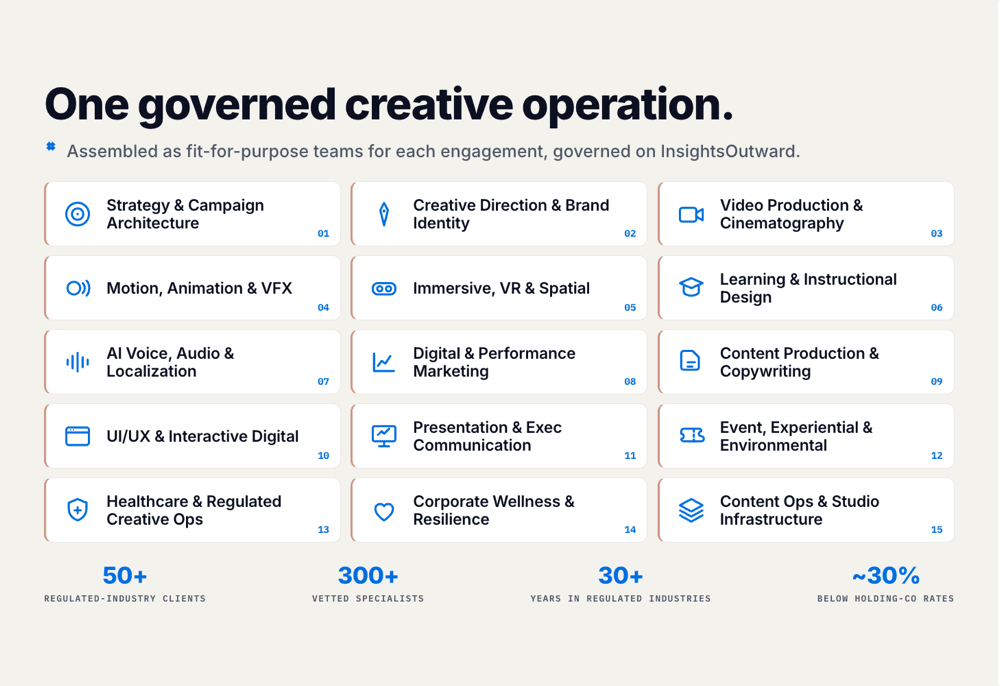
The model was built to flex — which is why AI does not threaten it. AI compounds it.
Because the Studios model was built to flex, AI does not threaten it — it compounds it. There is no standing roster of billable hours to defend, so faster delivery is passed to the client rather than withheld from them.
750+ regulated campaigns since 1996, at roughly 30% below holding-company rates, are what this structure produces.
The proof is in who buys it.
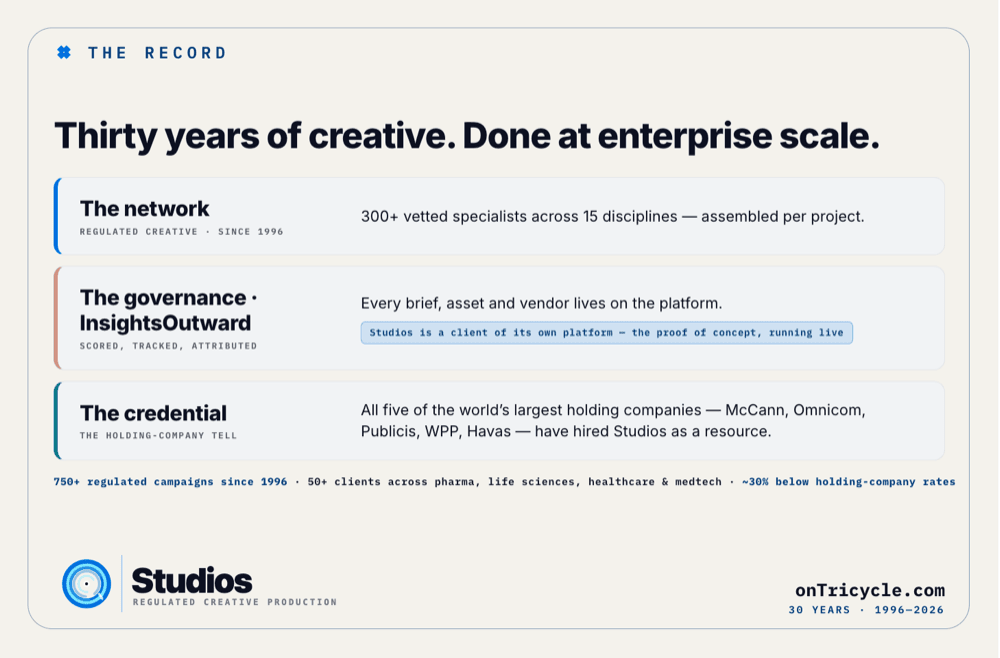
The five largest agency holding companies in the world — McCann, Omnicom, Publicis, WPP, Havas — have all hired Studios. Not as a competitor. As the regulated-industry creative capability they needed and could not build fast enough themselves.
When the companies that govern global creative operations call you in to do their most sensitive work, that is a structural verdict no awards shelf can deliver.
The network is not the deepest difference. What governs it is.
Every brief Studios runs, every creative asset it delivers, every vendor and resource it engages is tracked, scored, and attributed on InsightsOutward — the same platform Tricycle licenses to enterprise loyalty clients.
Before an asset reaches Legal, Medical, or Regulatory review, Sage — the InsightsOutward platform's AI + LLM layer — has scored it across dimensions including Compliance, Brand, Engagement, and Asset Clarity, or whichever standards our clients wish us to attribute. Preventable problems are resolved before a reviewer sees them, and the rework loop shrinks because scrutiny moved to the front of the process. Every vendor carries a live performance record instead of a reputation. Every production dollar is traceable to the outcome it bought.
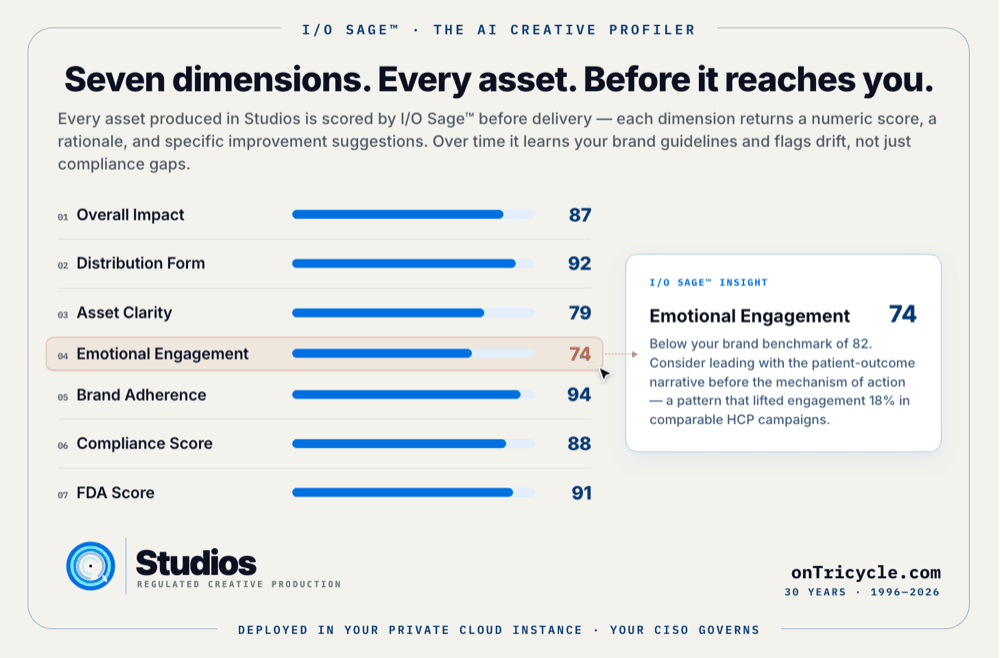
Most agencies depend on the client not looking too closely. Studios is the inverse.
Most agencies cannot show any of that, because the model depends on the client not looking too closely. Studios is the inverse: before you evaluate the creative, evaluate what governs it.
Studios is a client of its own platform — the proof of concept, running live.
When AI makes the team faster, does the bill go down — or does a bench need protecting?
So when the decision is who makes your most regulated, most scrutinized work in the age of AI, the question is structural: when AI makes the team faster, does the bill go down — or does a bench need protecting?
Studios has no bench to protect. It never did.
Questions about regulated creative in the age of AI
What is "the bench" in agency and holding-company creative?
Why does AI threaten the agency bench model?
How is the Tricycle Studios network different from a bench?
Does AI threaten the Studios network model?
Which agency holding companies have hired Tricycle Studios?
How does Studios govern regulated creative before legal and medical review?
See What Regulated Creative Looks Like Without a Bench.
If AI is making your creative faster but your rate card isn't moving, the problem is the model, not the work. We walk through how Studios assembles a purpose-built team of vetted specialists per project, governed on InsightsOutward — and how that structure delivers regulated campaigns at roughly 30% below holding-company rates.
Bring Us a Brief
A practitioner-led walkthrough of how Studios would assemble, govern, and deliver against your actual regulated creative work.
Talk to Us